











最新情報
最新の30件
2026.09.18
【資料】JST-CRDSの重要資料を共有します。
★俯瞰ワークショップ報告書「構造材料の革新と展望」
➡https://www.jst.go.jp/crds/report/index.html
★CRDS が着目する研究開発の潮流2026
➡https://www.jst.go.jp/crds/report/CRDS-FY2026-RR-03.html

2026.09.15
【学会】中野研究室のメンバーが日本金属学会2026年(第179回)秋期講演大会(@秋田大学手形キャンパス、9月23日~9月25日)に参加します。
以下の中野研関連発表が行われます
9月23日
〇横山 凌大、松坂 匡晃、松垣 あいら、中野 貴由:
[P101] 骨基質配向性制御が偽関節形成に与える影響
〇溝上 翔太、松坂 匡晃、松垣 あいら、中野 貴由:
[P244] 骨形成促進経路の活性化による骨芽細胞配列化への影響
〇趙 研、山下 葵平、齊藤 拓馬、佐々木 泰祐、中野 貴由、安田 弘行:
[S6.9] レーザー積層造形製IN718の力学特性に及ぼすセル状組織の影響
〇山下 葵平、趙 研、中野 貴由、安田弘行:
[S6.10] 金属積層造形製 Inconel 718 におけるδ相の析出挙動に及ぼすセル状組織の影響
〇平田 渉悟、小笹 良輔、佐藤 和久、今野 晋也、石田 清仁、中野 貴由:
[S6.11] L-PBFによる炭化物析出強化型Co基超合金の微細組織と力学特性の制御
〇星野 壮希、石本 卓也、眞山 剛、中野 貴由:
[S6.12] PBF-LB/Mを用いた孔構造・結晶方位の同時制御によるIN718における塑性変形挙動の解明
〇菊川 泰地、石本 卓也、多根 正和、中野 貴由:
[S6.13] PBF-LBを利用した結晶集合組織制御と弾性異方性解明
9月24日
〇小泉 雄一郎、奥川 将行、三津原 晟弘、中野 貴由:
[IS5] 金属Additive Manufacturingにおける超温度場材料創成のデジタルツイン科学
〇當代 光陽、アブドゥッラー ムハッマド、松木 心那、永瀬 丈嗣、中野 貴由:
[S4.9] TiZrHf ミディアムエントロピー合金への第4元素添加による力学特性の改善
〇奥川 将行、小泉 雄一郎、中野 貴由:
[S6.14] ステンレス鋼の粉末床溶融結合における急冷凝固のデジタルツイン解析
〇安田 弘行、趙 研、竹山 雅夫、中野 貴由:
[S6.21] Additive Manufacturing によるTiAl合金の組織制御
○辛島 崇仁、趙 研、竹山 雅夫、中野 貴由、安田 弘行:
[S6.22] 電子ビーム3Dプリンタ製β相含有TiAl合金の力学特性安定性とクリープ挙動
○渡辺 悠哉、趙 研、竹山 雅夫、中野 貴由、安田 弘行:
[S6.23]金属積層造形製酸素添加型β相含有TiAl合金の組織制御
〇宮澤 啓太郎、小笹 良輔、中野 貴由:
[S6.25]L-PBFで作製したTi-42Nb合金の低サイクル疲労挙動
田原 正樹、陳 成、野平 直希、原島 亜弥、小笹 良輔、石本 卓也、小泉 雄一郎、中野 貴由、細田 秀樹:
[S6.28] 金属積層造形で作製したTi-Cr-Sn合金の変形・変態挙動
○石本 卓也、前川 翔、真中 智世、佐藤 和久、中野 貴由:
[S6.29] β相低安定性を用いたチタン合金間マルチマテリアル界面創製
○Yebeen Ji, Prince Valentine Cobbinah, Chincheng Tsai, Takayuki Shiraiwa, Yoshiaki Toda, Ryosuke Ozasa, Takuya Ishimoto, Takayoshi Nakano, Yoko Yamabe-Mitarai:
[S6.30] Localized α' Martensite Refinement in Ti6246 during Multi Track Laser Surface Melting of Ti Based Alloys
〇竹下 恭平、中西 陽平、松坂 匡晃、松垣 あいら、中野 貴由:
[313]材料表面ナノ周期構造による特異な基質直交配向化機構
〇森 陶子、松坂 匡晃、松垣 あいら、中野 貴由:
[315] 非侵襲的外部刺激による細胞配列制御を介した早期骨再建
〇磯谷 太一、松坂 匡晃、松垣 あいら、中野 貴由:
[316] 骨粗鬆症治療薬による異方性骨微細構造変化
〇齊藤 光郁、松垣 あいら、中野 貴由:
[317] I型糖尿病マウスにおける骨基質配向性変化
〇松坂 匡晃、松垣 あいら、石原 一彦、中野 貴由:
[319] 骨芽細胞配列化に基づく機能的骨組織再生に向けたマイクロパターンMPC-Ti材料の創製
9月25日
〇小笹 良輔、萩原 幸司、松本 敏治、中野貴由:
[S6.33] L-PBFによるMg-0.5Ca合金の結晶集合組織制御と力学特性
〇Yan Jinge、小笹 良輔、Gokcekaya Ozkan、中野 貴由:
[S6.34] レーザ粉末床溶融法で作製したAlCo系共晶ハイエントロピー合金における急速凝固誘起単相B2のデカップル成長
〇大川 翔、小笹 良輔、萩原 幸司、松本 敏治、中野貴由:
[S6.35] L-PBF で作製したLPSO型Mg合金の力学特性と変形挙動
2026.09.13
【講演】第28回骨粗鬆症学会(新潟朱鷺メッセ)で中野先生がシンポジウム講演を行いました。
中野貴由:
骨強度を支配するコラーゲン/アパタイト骨基質配向性の基礎、
第28回日本骨粗鬆症学会学術集会(会長:山本智章先生、倉林工先生)、
シンポジウム32(3-SY32) 「メディカルスタッフのための骨強度の基礎知識」、
2026年9月13日(日) 10:30~12:00、朱鷺メッセ新潟コンベンションセンター
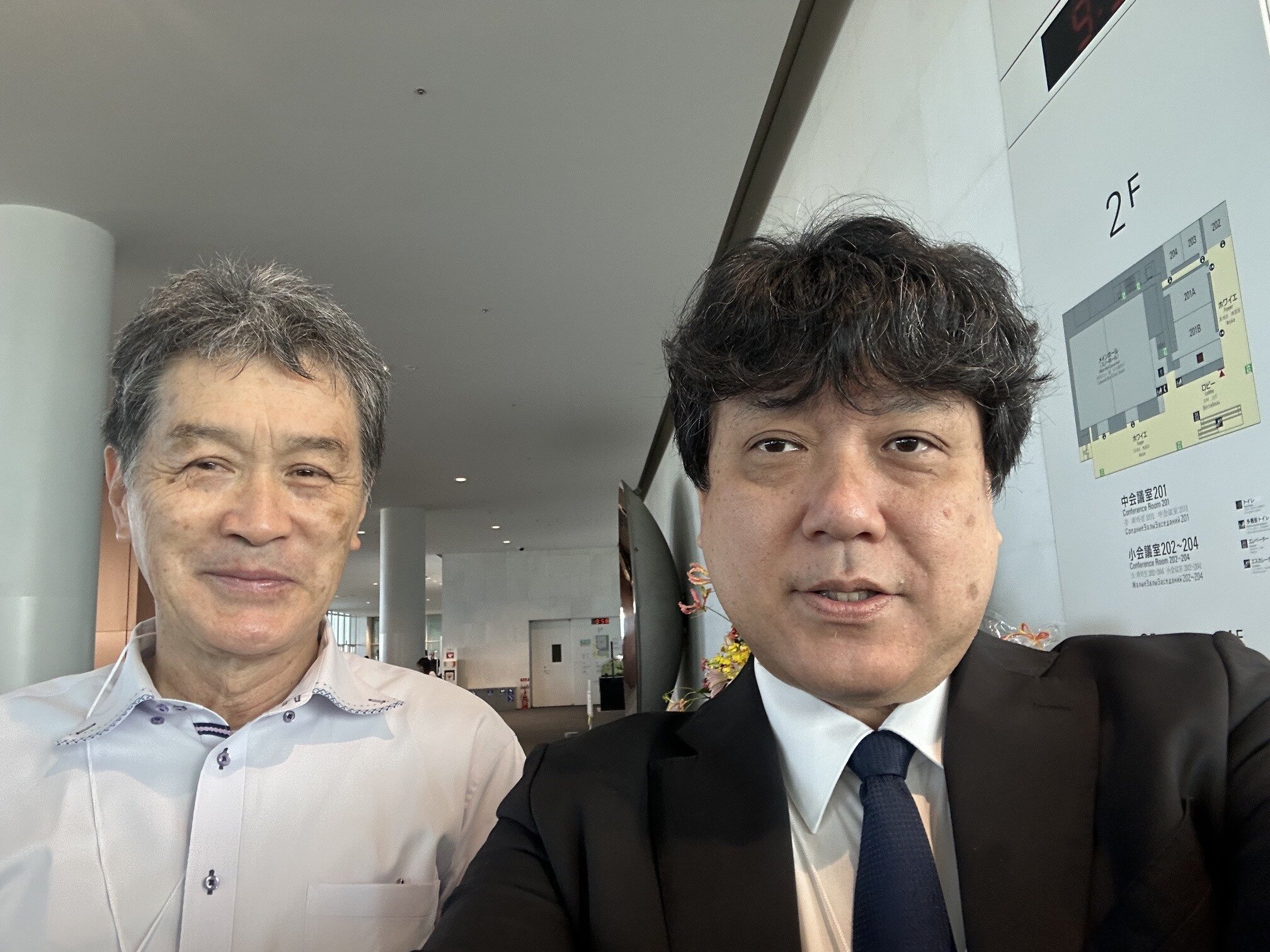
学会長の山本先生とともに
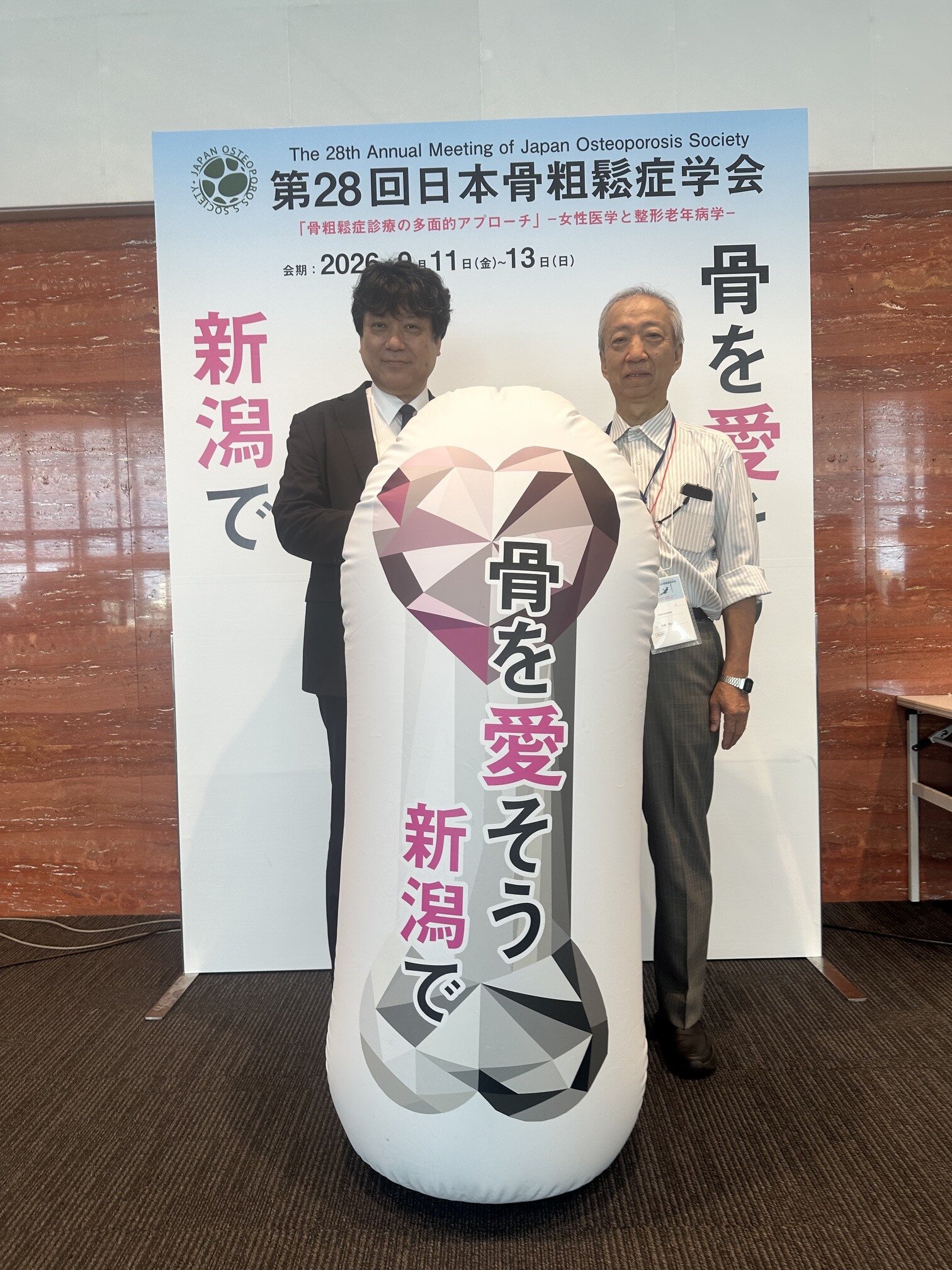
大和先生とともに
2026.09.11
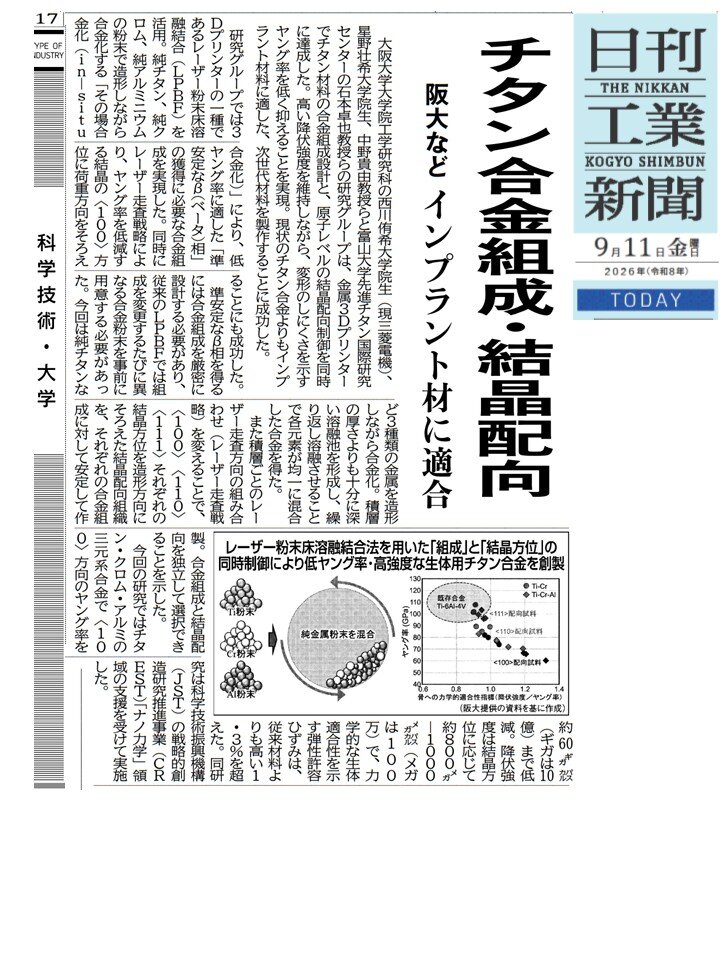
【新聞】純元素粉末を出発材にしたAMによってTi-Cr-Al合金の相安定性を連続的に選択することに成功し、機能性の制御が可能であることを示した成果に関する記事が、本日の日刊工業新聞の17面のトップ記事として掲載されました。
チタン合金組成・結晶配向 阪大など インプラント材に適合 日刊工業新聞 2026年9月11日 朝刊17面
2026.09.10
【行事】毎年恒例の研究室旅行を行い大いに盛り上がりました。
9月9日、10日に中野研恒例の研究室旅行が開催されました。
今回は中野研初?の鳥取県に訪れました。
様々なレクリエーションや体験を行い、研究室内の親睦を深めることができました!
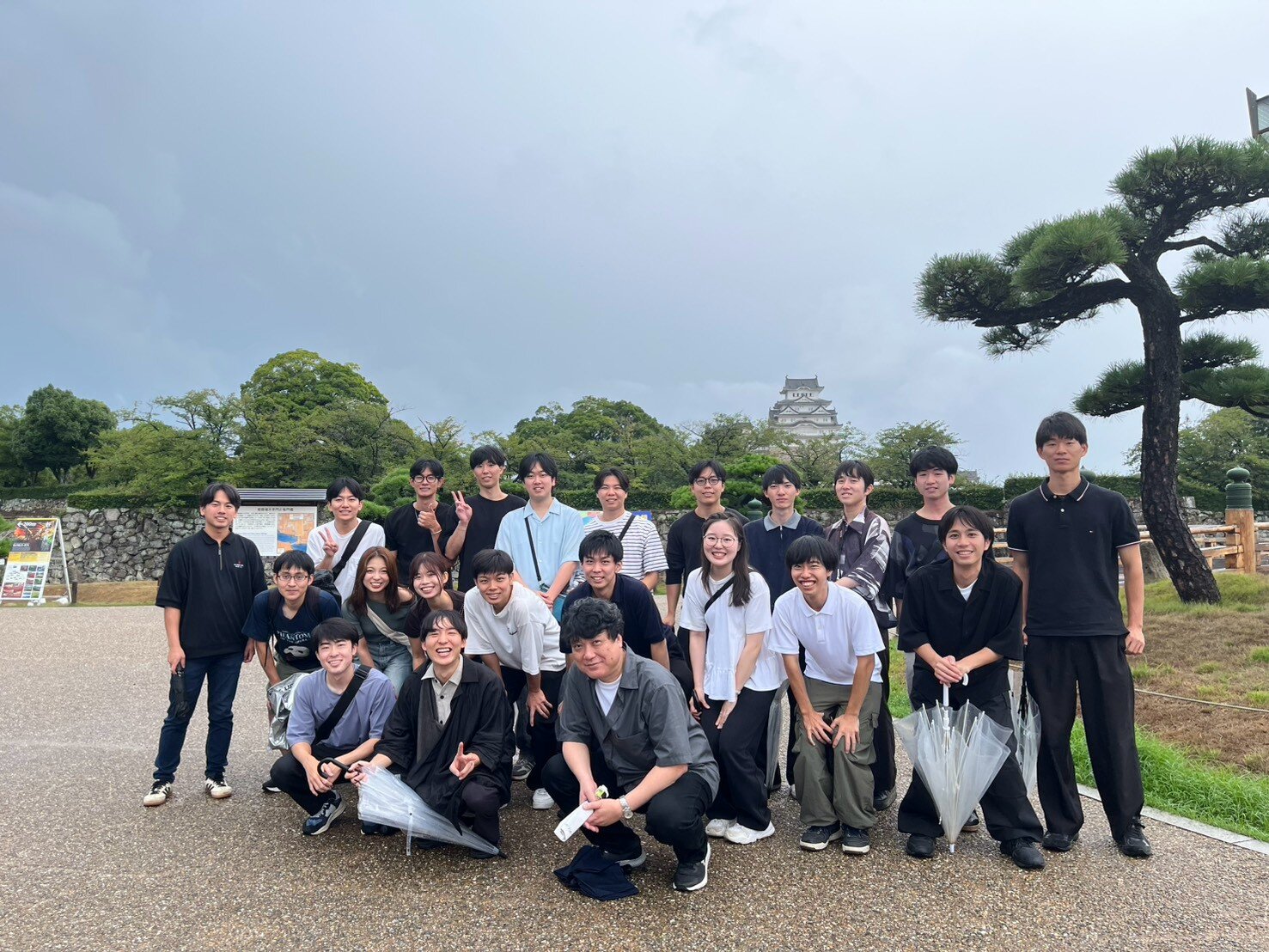
姫路城にて
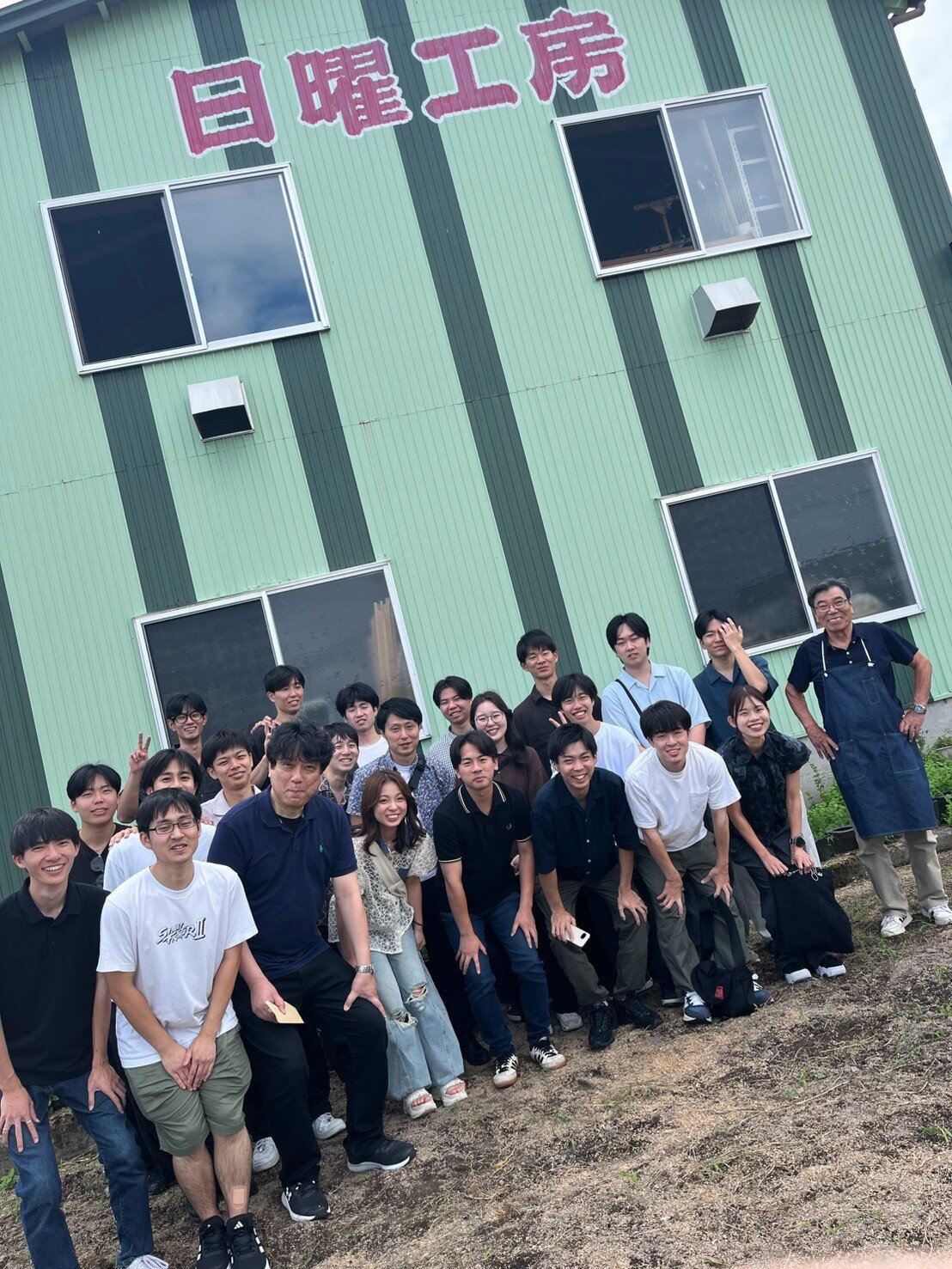
お箸づくり体験をした日曜工房にて
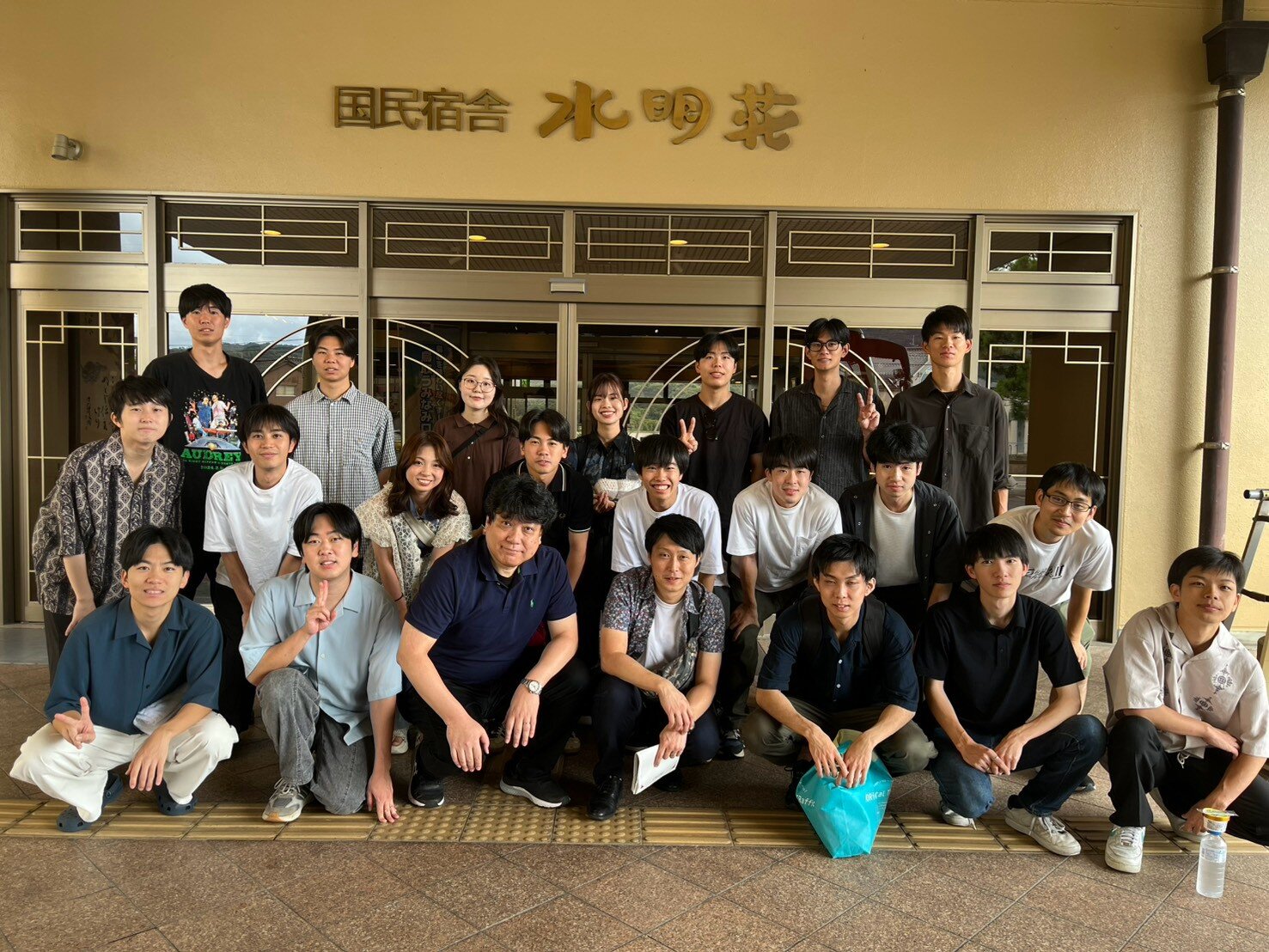
国民宿舎 水明壮にて
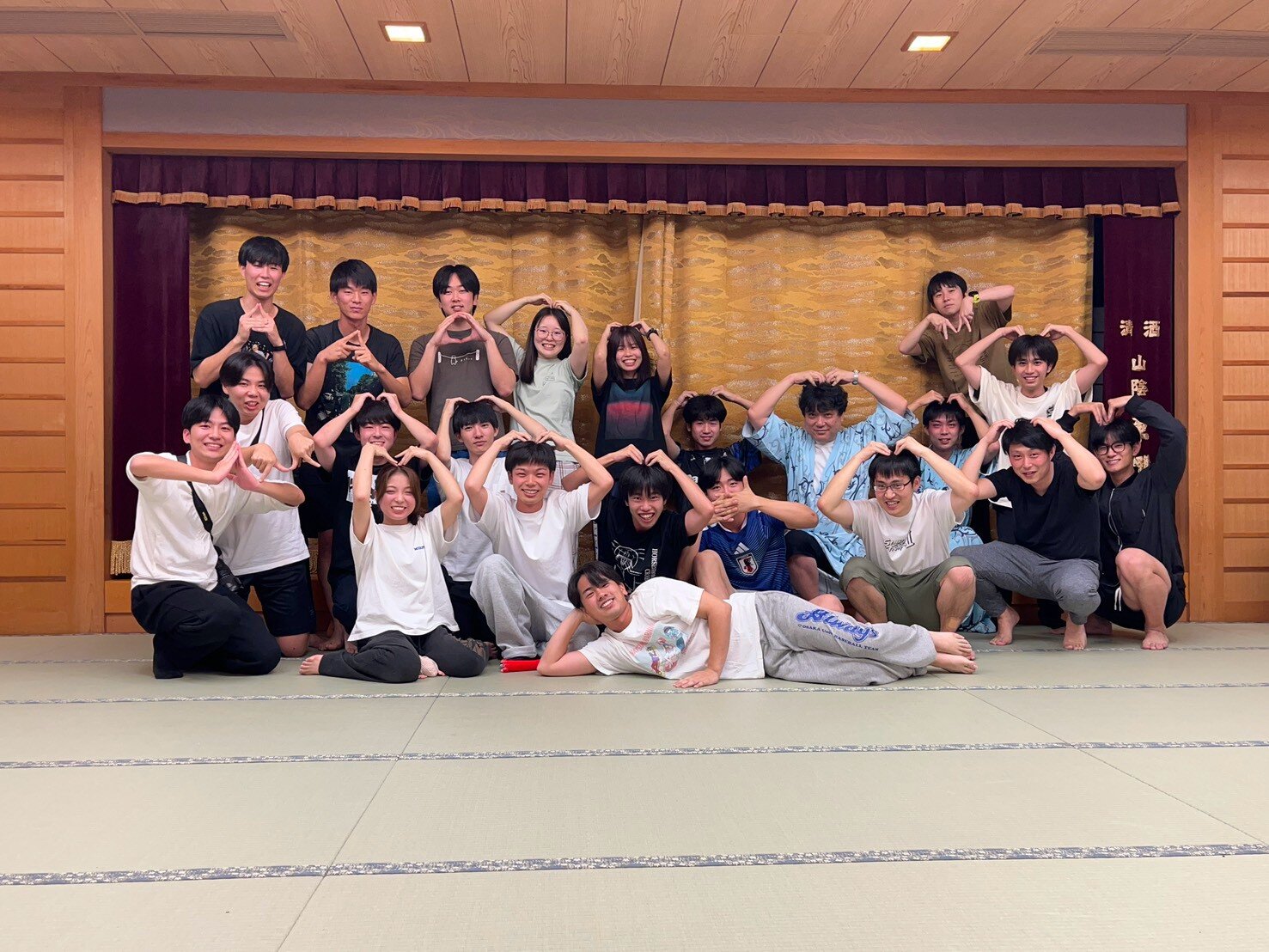
宴会の様子(ポーズはAdditive Manufacturingの"M")
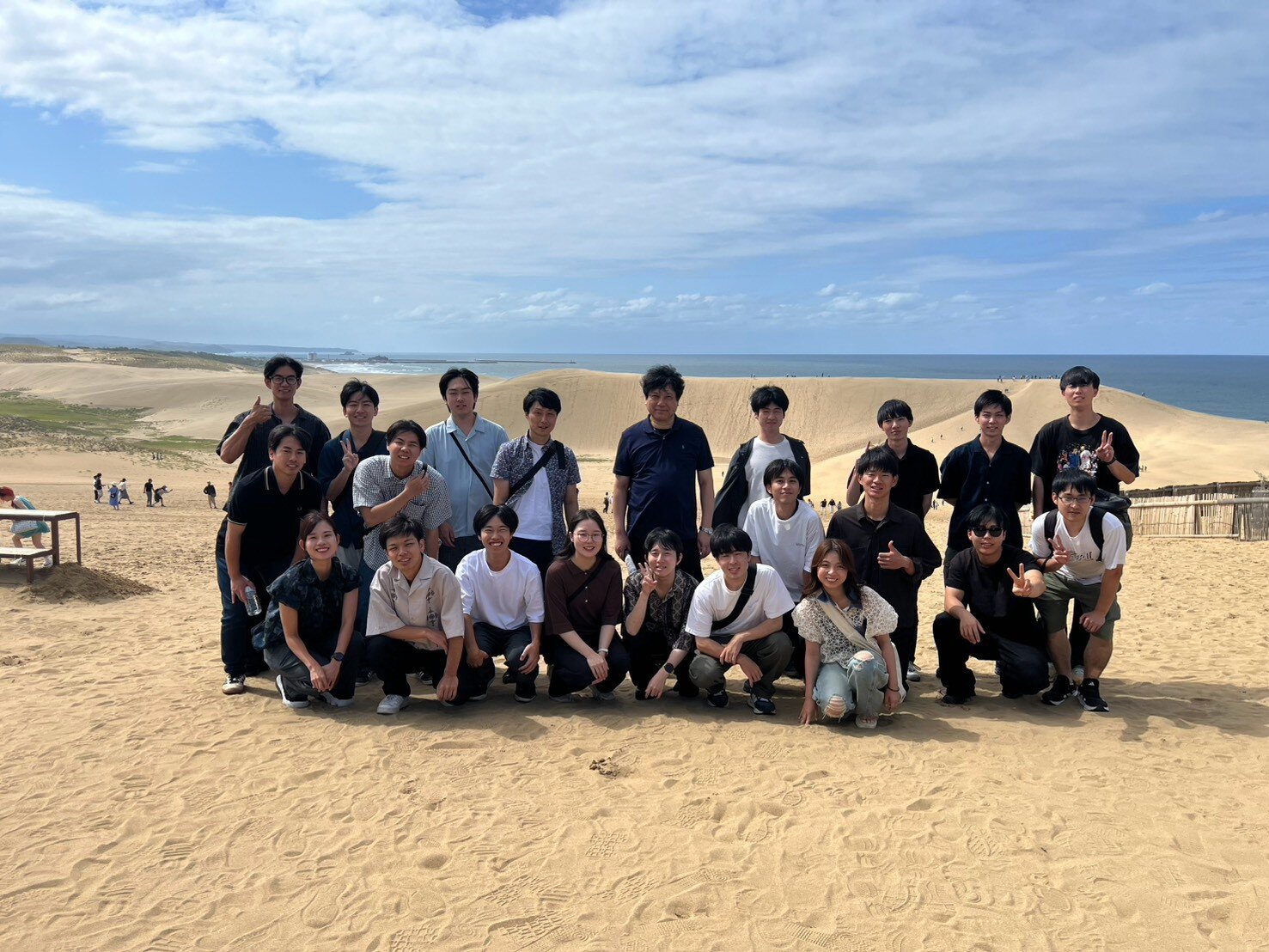
鳥取砂丘にて
2026.09.08
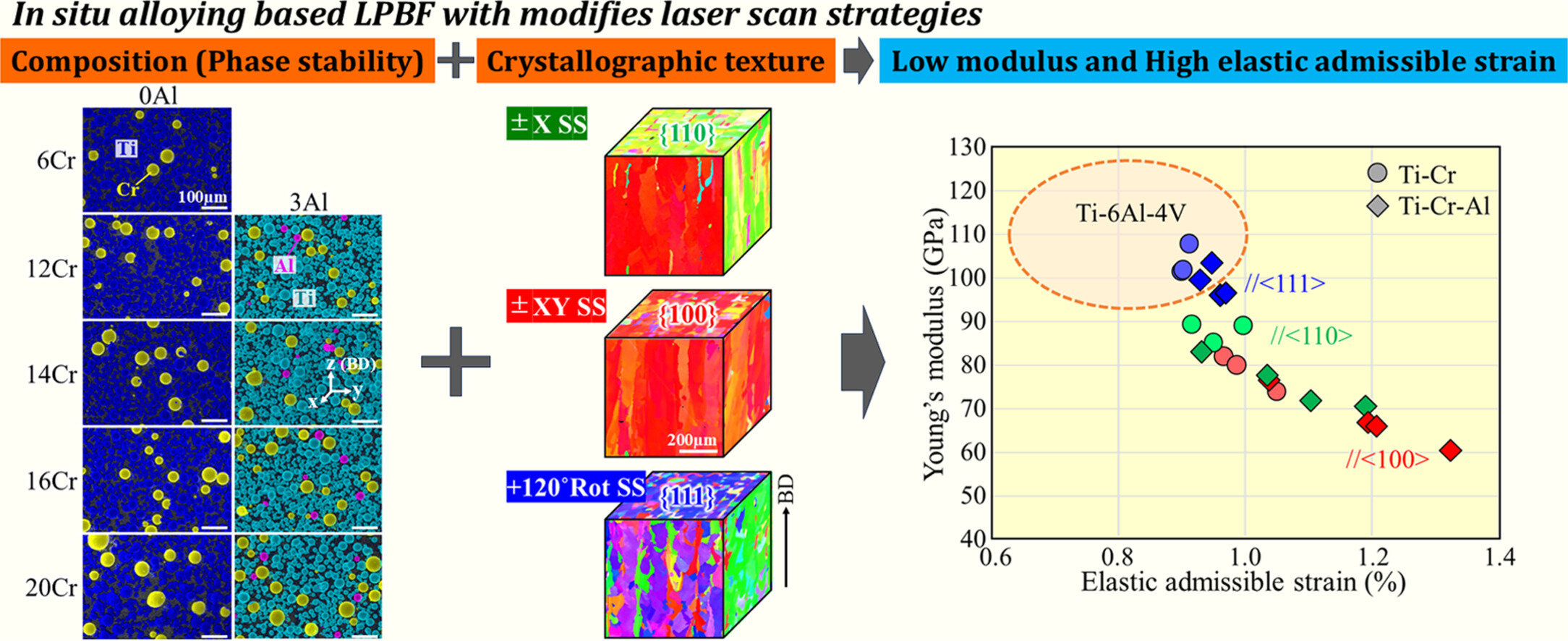
【論文】Acta Materialia(IF=10.7)にLPBFで形成したβTi合金のω相安定性と結晶配向性制御に関する論文が、OA論文として掲載されました。
Takuya Ishimoto, Soki Hoshino, Yuki Nishikawa, Masakazu Tane, Kazuhisa Sato, Hyoung Seop Kim, Takayoshi Nakano*:
Simultaneous control of phase stability and crystallographic texture for low-modulus biomedical β-type Ti-Cr-Al alloys by in-situ alloying LPBF,
Acta Materialia, 320, (2026), 122715: 1-13.
DOI: https://doi.org/10.1016/j.actamat.2026.122715
論文はこちら
PDFはこちら
Abstract
Laser powder bed fusion (LPBF) offers not only geometric freedom, but also a unique route to co-design composition-based phase stability and crystallographic texture, which are critical for realizing low-modulus Ti alloys. In this study, we fabricated Ti-Cr and Ti-Cr-Al alloys by the in situ alloying of elemental powders and programmed single-crystal-like textures (<100>, <110>, or <111> // build direction (BD)) via tailored scanning strategies. By employing processing conditions that yielded a melt pool depth far greater than the layer thickness, compositionally uniform builds were achieved through multiple remelting events. In Ti-12Cr (mass%), which has relatively low β-phase stability, the ω phase was observed despite not being detected in its solution-treated-and-quenched counterpart. This observation suggests that the LPBF-specific thermo-mechanical history, including a tensile residual stress of 353 MPa, may have contributed to ω-phase formation. The addition of Al suppressed the formation of ω, resulting in a single-phase β matrix. Furthermore, scan-strategy-dependent textures were consistently observed across all the compositions. The elastic modulus showed pronounced orientation-dependent anisotropy, reaching ∼60 GPa along <100> in a Ti-12Cr-3Al composition, whereas the BD-parallel yield strength approached 800-1,000 MPa depending on the texture, producing elastic admissible strains that surpass those of reported LPBF-fabricated Ti-6Al-4V. Based on these findings, we propose an additive manufacturing process-aware design framework in which alloy composition, LPBF-specific thermo-mechanical history, and crystallographic texture contribute collectively to phase stability and directional mechanical properties in metastable β-Ti alloys.
keywords: β-Ti alloy; in situ alloying; laser powder bed fusion; phase stability; crystallographic texture; Young's modulus
2026.09.07
【HP】ヒット数が44万件を突破!
中野研HPのヒット数が44万件を突破しました。
いつもご覧いただき、ありがとうございます。
2026.09.07
【解説】チタン誌に解説が掲載されました。
奥川将行, 小泉雄一郎, 中野貴由:
Ti合金の粉末床溶融結合型金属3Dプリントにおける粉末レーキ過程の個別要素法解析,
チタン誌, 74[3], (2026), 190-194
PDFはこちら
2026.09.04
『Advanced Materials & Processes』にデジタルツインと粒子法流動シミュレーションを活用した材料プロセス高度化に関する解説記事が掲載されました。
Hideyuki Kanematsu, Jeremy Knopp, Akiko Ogawa, Takayoshi Nakano:
DIGITAL TWIN AND FLOW SIMULATION FOR IMPROVED MATERIALS PROCESSING
-Beyond simulation, the real power of a digital twin is the closed feedback loop, which provides valuable digital-side visualization, enabling accelerated materials development,
Advanced Materials & Processes, 184 [5], (2026), 23-25.
PDFはこちら
2026.09.03
【受賞】日本Additive Manufacturing学会 第二回講演大会(@函館サーモン・まるなまアリーナ)にてM2平田君とM1永野君が優秀ポスター賞を受賞しました。
〇平田 渉悟、小笹 良輔、佐藤 和久、今野 晋也、石田 清仁、中野 貴由:
[P-B-18] L-PBFを用いた炭化物析出強化型Co基超合金の開発
〇永野 登基、小笹 良輔、中野 貴由:
[P-B-17] L-PBFによる純Znの結晶集合組織と力学特性
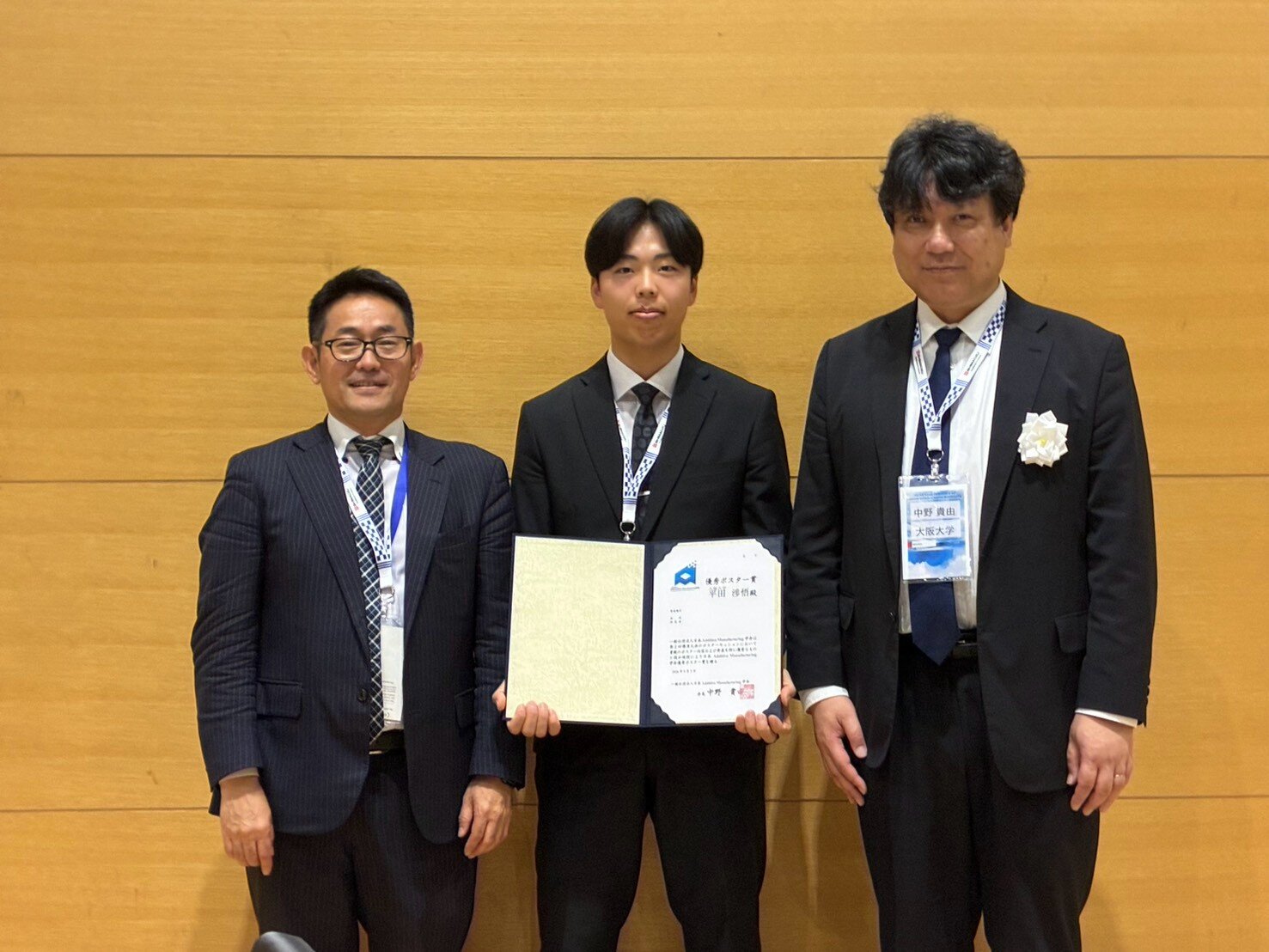
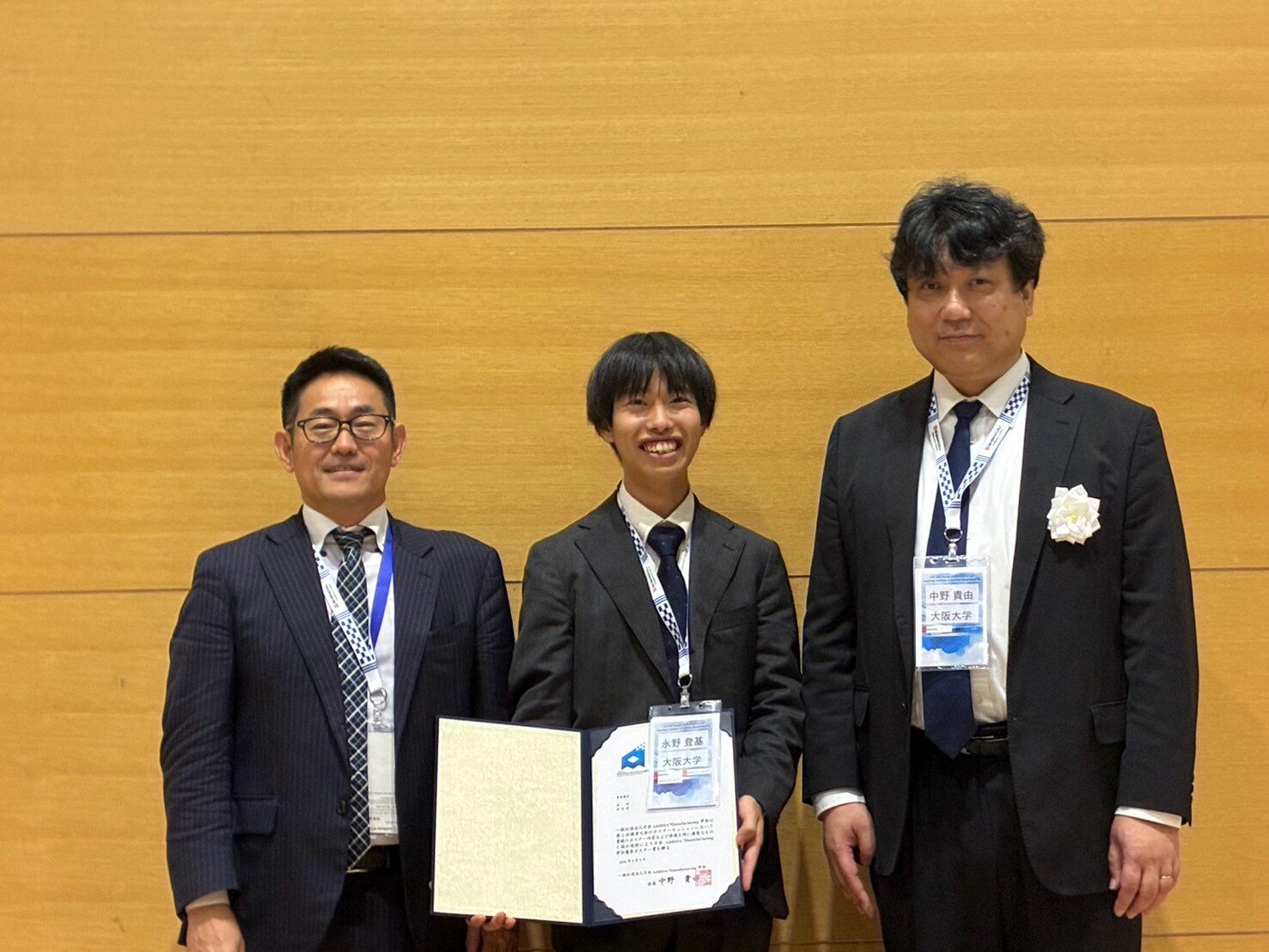
学会副会長で実行委員長の渡邊誠先生(NIMS)とともに
2026.09.02
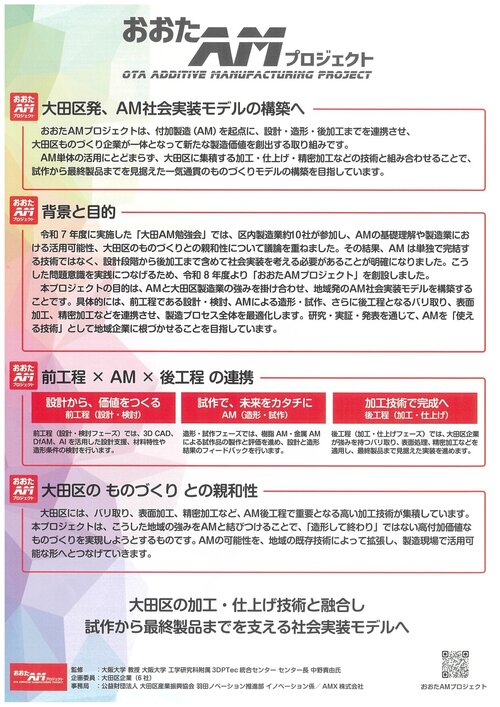
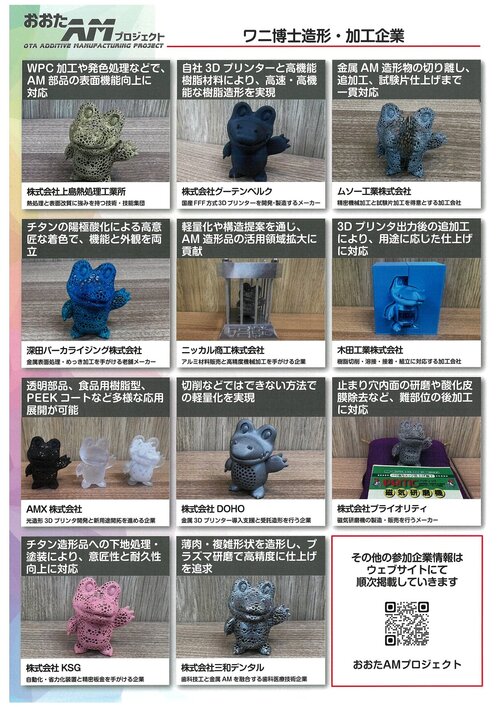
【大田AMPJ】中野先生が監修するおおたAMプロジェクトの成果発表と展示を日本AM学会第2回講演大会(札幌)で行いました。
2026.09.02
【新聞】中野先生が会長を務める日本AM学会の第二回講演大会(9月1日~3日@函館)の様子が日刊工業新聞に掲載されました。
AM学会、函館で講演大会 日刊工業新聞 2026年9月2日 朝刊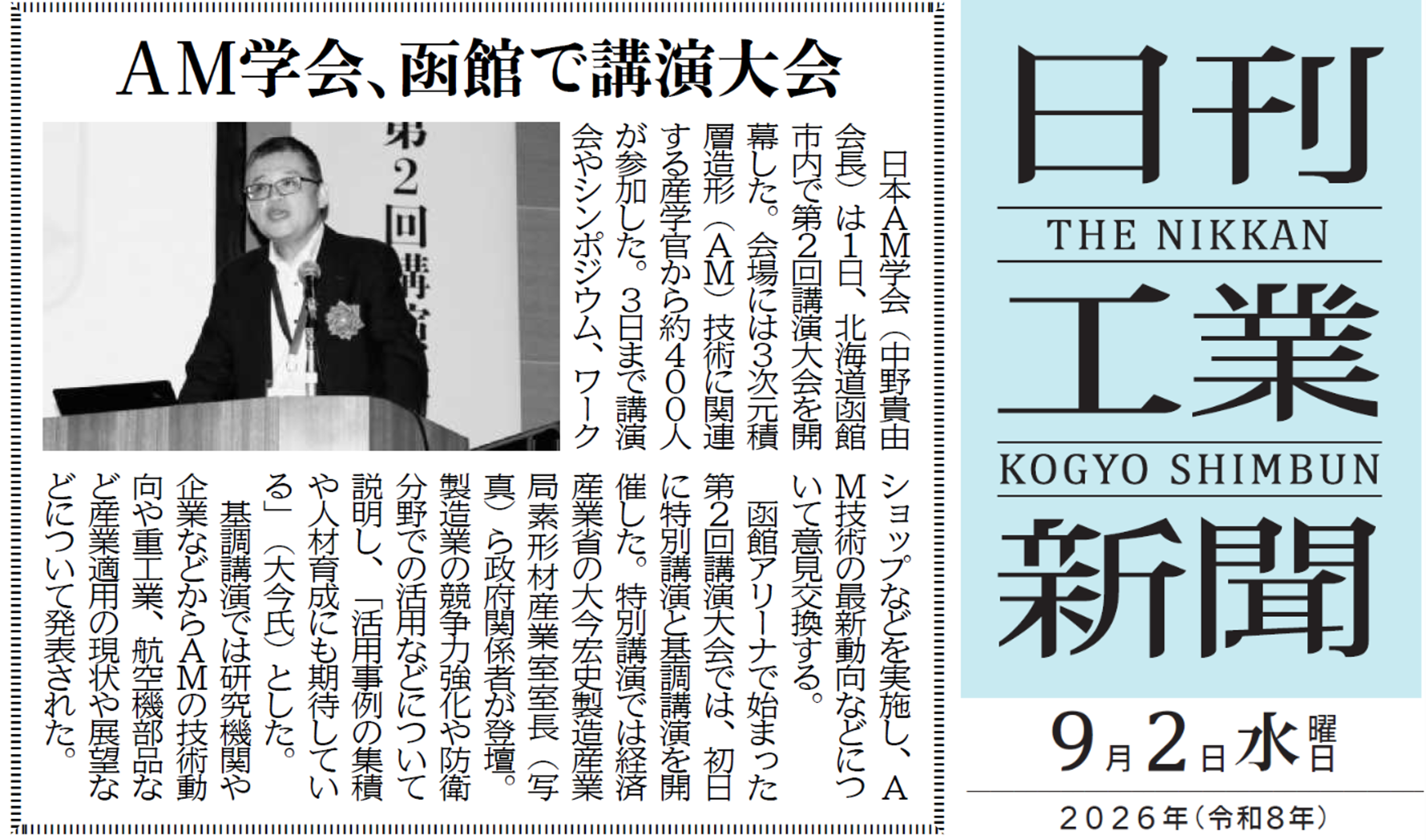
2026.09.01
【学会】中野先生が会長を務める日本Additive Manufacturing学会の第二回講演大会(@函館サーモン・まるなまアリーナ(函館アリーナ)、9月1日~9月3日)が開催され、大いに盛り上がりました。
中野先生が会長を務める日本Additive Manufacturing学会の第二回講演大会が北海道の函館市で開催され、大いに盛り上がりました。産官学から多くの研究者・技術者が参加し、大盛況の会となりました。1日目の夜には懇親会が開催され、250名以上が集結しました。
★日本AM学会講演大会の様子→
https://ji-am.jp/2026/09/lecture_conference_2-1/
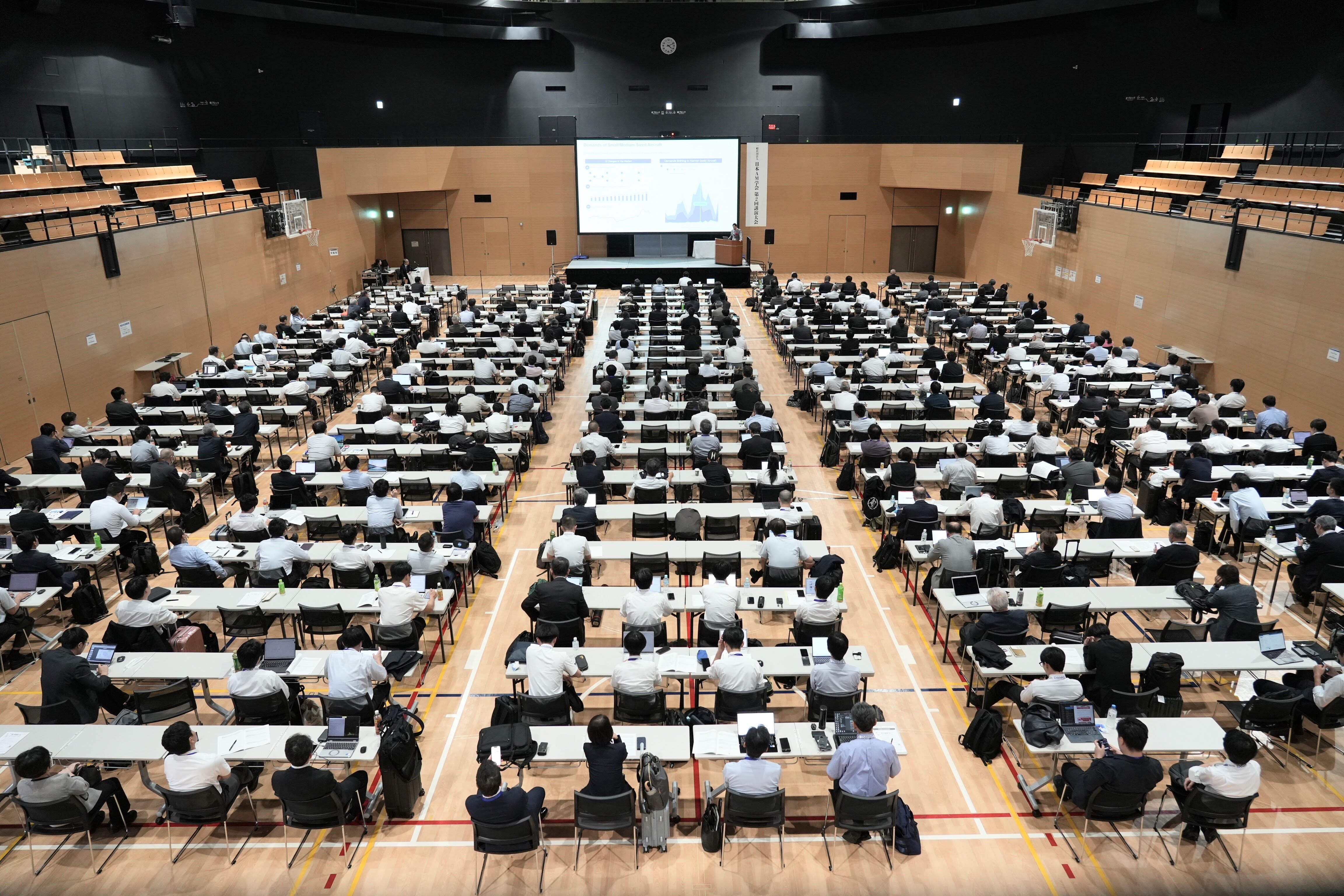
会場の様子
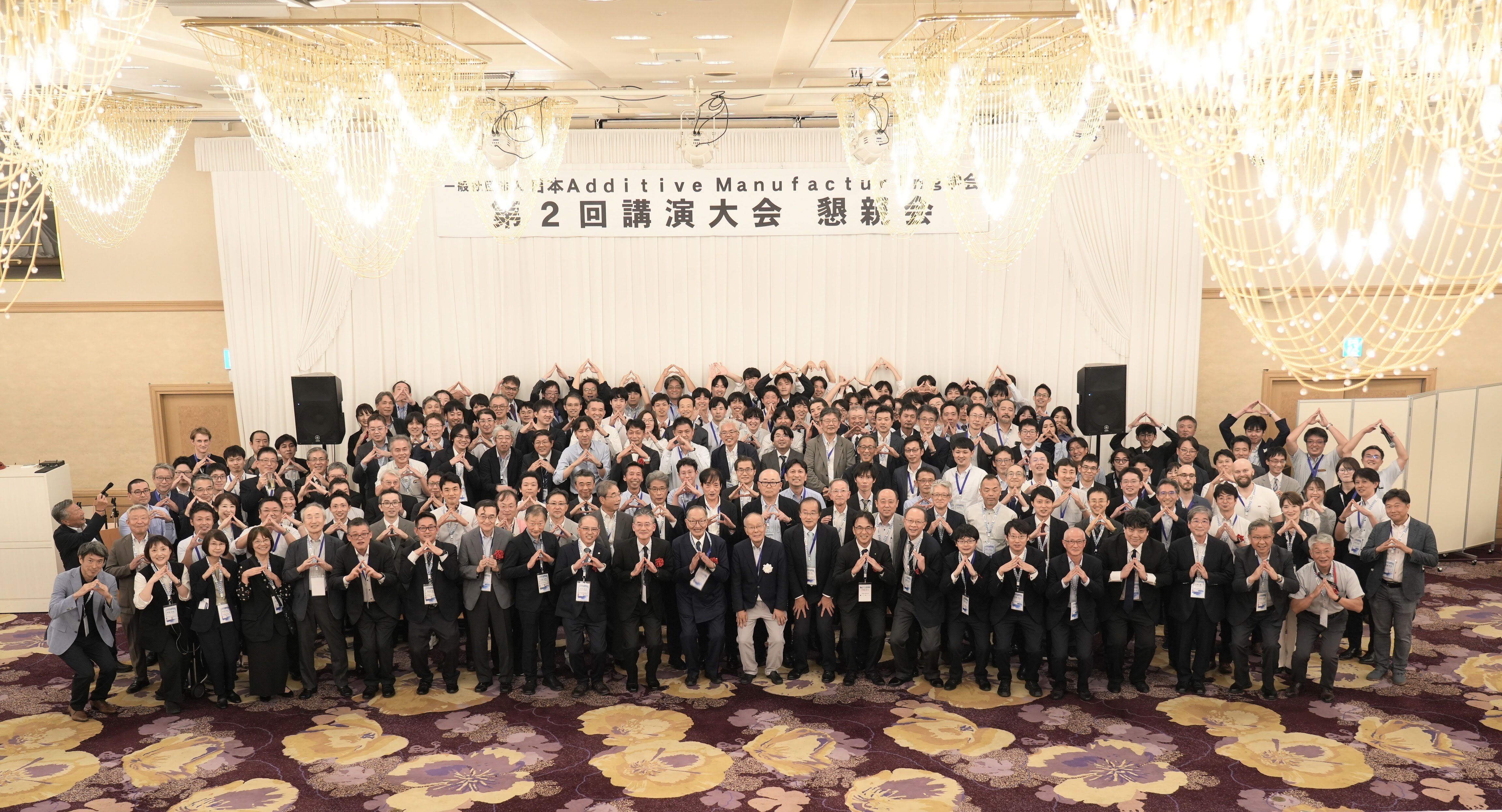
懇親会の様子(ポーズはAdditive Manufacturingの"A")
2026.09.01
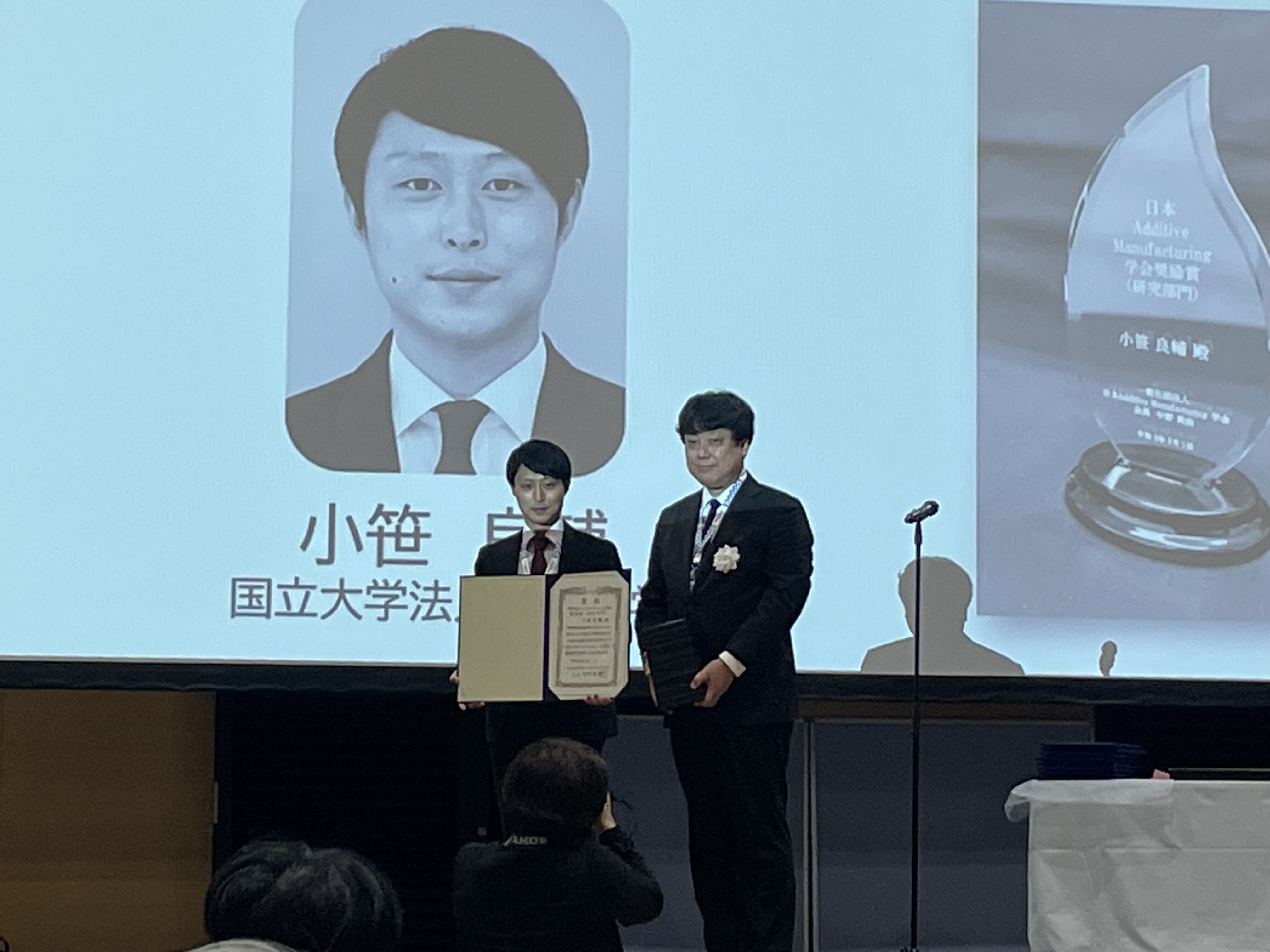
【受賞】日本Additive Manufacturing学会 第二回講演大会(@函館サーモン・まるなまアリーナ(函館アリーナ)、9月1日~9月3日)にて、小笹先生が奨励賞(研究部門)を受賞しました。9月3日には受賞講演が行われます。
〇小笹 良輔:
[AL-A2-01 : 奨励賞] レーザ粉末床溶融結合による微細組織と力学特性の制御
~FCC・BCC構造からHCP構造への新展開~
2026.09.01
【学会】日本Additive Manufacturing学会 第二回講演大会(@函館サーモン・まるなまアリーナ(函館アリーナ)、9月1日~9月3日)に参加しています。
中野先生が会長を務める日本AM学会の第2回講演大会が北海道函館市で開催されています。
発表一覧
2026年9月3日
受賞講演
〇小笹 良輔:
[AL-A2-01 : 奨励賞] レーザ粉末床溶融結合による微細組織と力学特性の制御
~FCC・BCC構造からHCP構造への新展開~
一般講演
〇瀬口 侑右、谷原 康友、小笹 良輔、奥川 将行、多根 正和、中野 貴由:
[G-M1-01] 熱解析モデルを援用した機械学習によるワイヤレーザDED製Ti-6Al-4V造形体の硬さ分布予測
〇熊谷 祥希、髙橋 茉莉、Santos Batista Rui João、小笹 良輔、中野 貴由:
[G-M7-01] レーザ粉末床溶融結合法による熱間ダイス鋼の高温予熱造形
〇石本 卓也、星野 壮希、西川 侑希、多根 正和、中野 貴由:
[G-A1-03] In-situ alloying LPBFによる低ヤング率β型Ti合金の相安定性および結晶集合組織の同時制御
〇星野 壮希、石本 卓也、眞山 剛、中野 貴由:
[G-B1-04] L-PBF法による孔・結晶方位の相互作用に基づくIN718における塑性変形挙動制御
〇加藤 美里、矢地 謙太郎、小笹 良輔、藤田 喜久雄、中野 貴由:
[G-B2-05] 金属積層造形における異方性機能設計:トポロジー最適化による形状と結晶配向の同時設計
〇Ozkan Gokcekaya, Sung-Hyun Park, Takayoshi Nakano:
[G-C1-02] The effect of process parameters on microstructural evolution and mechanical properties of βsolidifying γ-TiAl alloy fabricated by laser powder bed fusion
〇閻 金戈、小笹 良輔、Gokcekaya Ozkan、中野 貴由:
[G-C2-04] LPBF により作製した AlCo 基共晶ハイエントロピー合金における急速凝固誘起単相 B2 相のデカッ プル成長
ポスターセッション
〇劉 甜、松坂 匡晃、松垣 あいら、中野 貴由:
[P-A-14] 積層造形Ti-6Al-4Vによる骨芽細胞配向誘導を介した抗菌制御
〇NUR ZULAIKHA BINTI MOHAMAD ZAIDI, Ozkan Gokcekaya, Takayoshi Nakano:
[P-A-16] Crystallographic Texture Control in Additive Manufacturing of Tantalum for Biomedical Applications
〇峰元 智大、小笹 良輔、石本 卓也、中野 貴由、多根 正和:
[P-A-17] L-PBF法で作製したTi-Cr合金の弾性特性
〇永野 登基、小笹 良輔、中野 貴由:
[P-B-17] L-PBFによる純Znの結晶集合組織と力学特性
〇平田 渉悟、小笹 良輔、佐藤 和久、今野 晋也、石田 清仁、中野 貴由:
[P-B-18] L-PBFを用いた炭化物析出強化型Co基超合金の開発
〇菊川 泰地、石本 卓也、眞山 剛、多根 正和、中野 貴由:
[P-B-19] PBF-LB/Mを活用したNi基合金へのマクロ界面導入による高強度化
〇大川 翔、小笹 良輔、萩原 幸司、松本 敏治、中野 貴由:
[P-B-20] L-PBFによるLPSO型Mg合金の微細組織と力学特性の制御
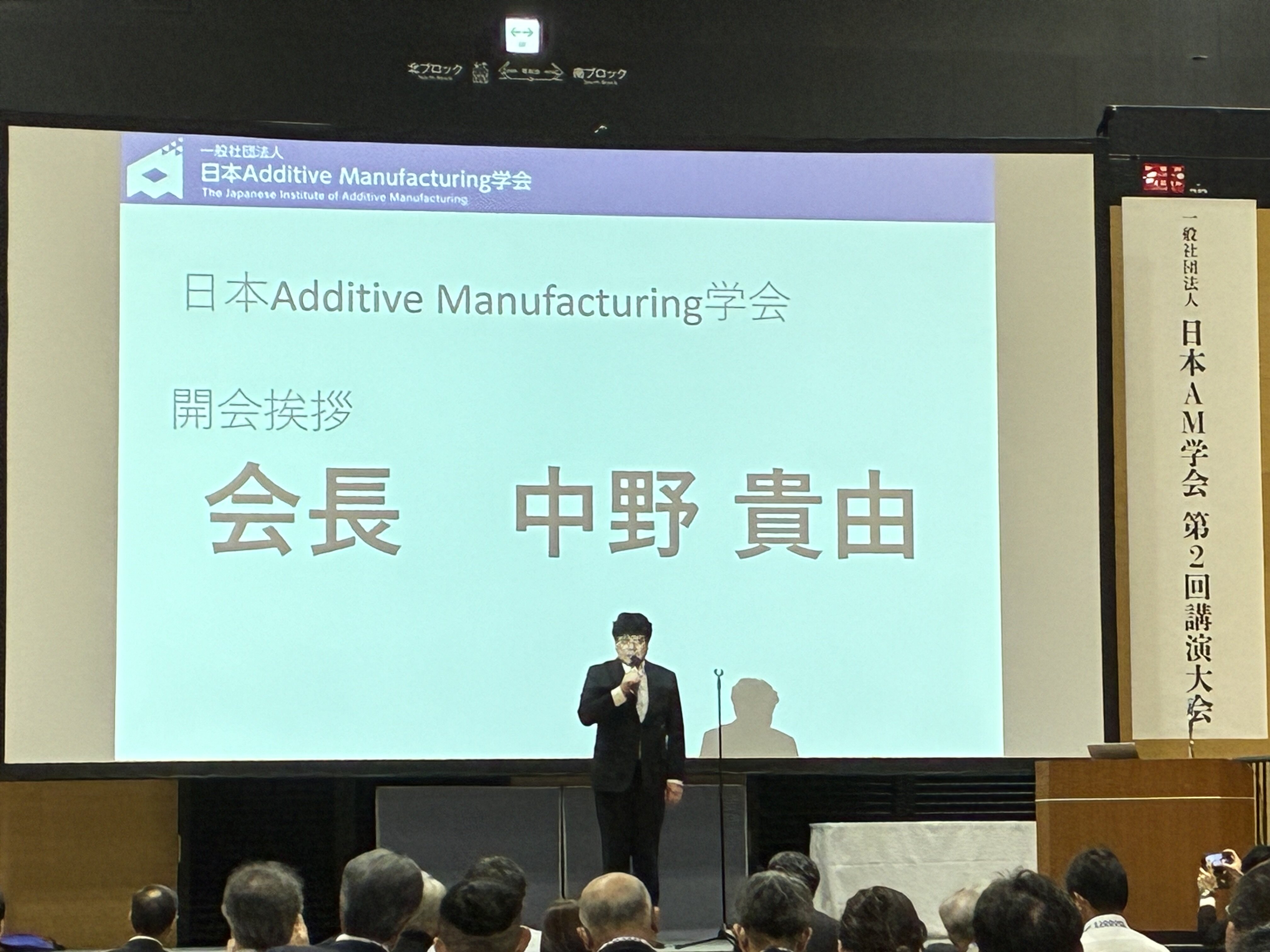
開会挨拶の様子
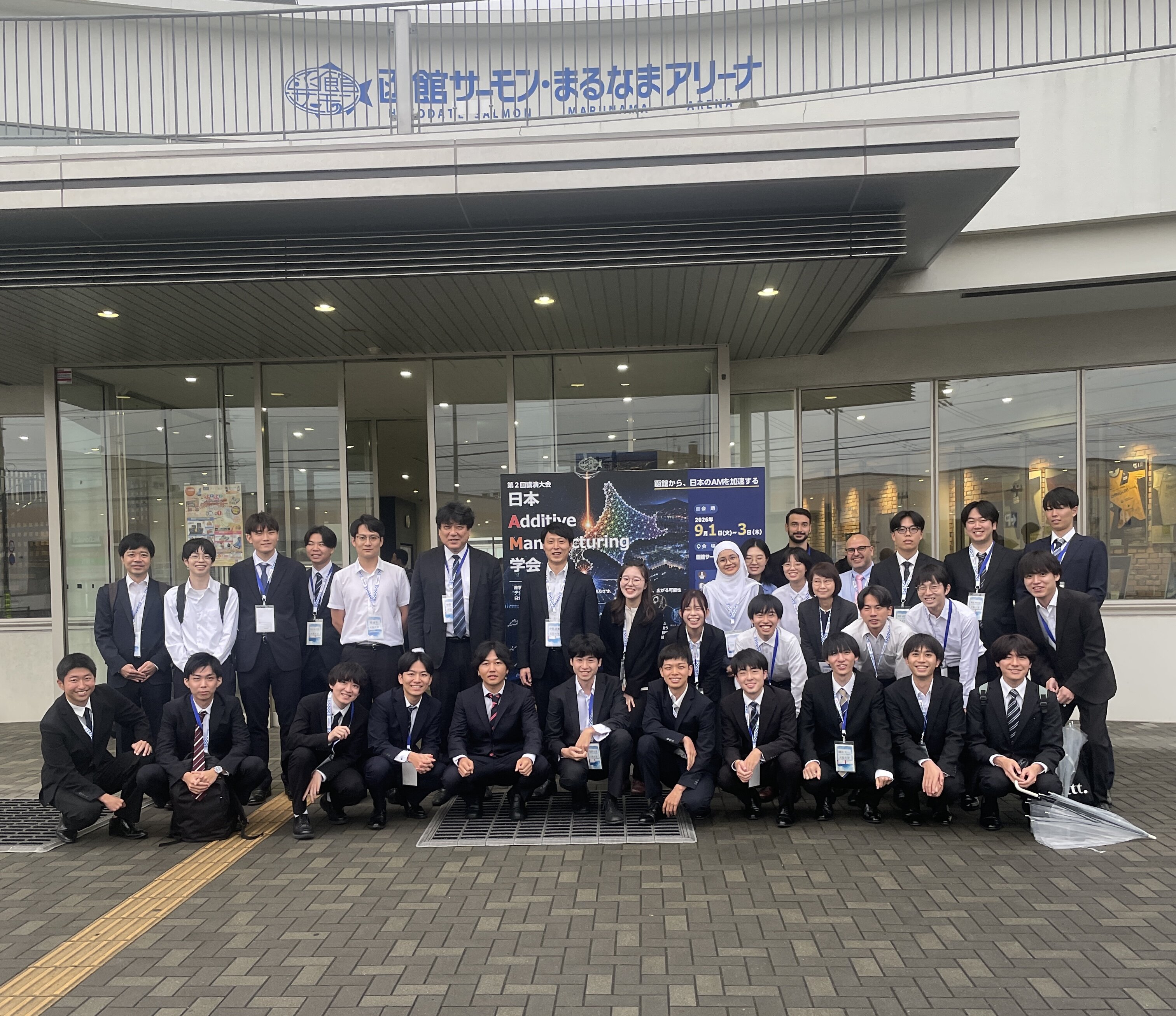
集合写真(ナカシマヘルスフォースの皆様、富山大学石本研の皆様とともに)
2026.09.01
【論文】Acta Materialia(IF=10.7)にLPBFで形成したβTi合金のω相安定性と結晶配向性制御に関する論文が、OA論文としてオンラインで掲載されました。
Takuya Ishimoto, Soki Hoshino, Yuki Nishikawa, Masakazu Tane, Kazuhisa Sato, Hyoung Seop Kim, Takayoshi Nakano*:
Simultaneous control of phase stability and crystallographic texture for low-modulus biomedical β-type Ti-Cr-Al alloys by in-situ alloying LPBF, Acta Materialia, (2026), 122715.
DOI: https://doi.org/10.1016/j.actamat.2026.122715
論文はこちら
Abstract
Laser powder bed fusion (LPBF) offers not only geometric freedom, but also a unique route to co-design composition-based phase stability and crystallographic texture, which are critical for realizing low-modulus Ti alloys. In this study, we fabricated Ti-Cr and Ti-Cr-Al alloys by the in situ alloying of elemental powders and programmed single-crystal-like textures (<100>, <110>, or <111> // build direction (BD)) via tailored scanning strategies. By employing processing conditions that yielded a melt pool depth far greater than the layer thickness, compositionally uniform builds were achieved through multiple remelting events. In Ti-12Cr (mass%), which has relatively low β-phase stability, the ω phase was observed despite not being detected in its solution-treated-and-quenched counterpart. This observation suggests that the LPBF-specific thermo-mechanical history, including a tensile residual stress of 353 MPa, may have contributed to ω-phase formation. The addition of Al suppressed the formation of ω, resulting in a single-phase β matrix. Furthermore, scan-strategy-dependent textures were consistently observed across all the compositions. The elastic modulus showed pronounced orientation-dependent anisotropy, reaching ∼60 GPa along <100> in a Ti-12Cr-3Al composition, whereas the BD-parallel yield strength approached 800-1,000 MPa depending on the texture, producing elastic admissible strains that surpass those of reported LPBF-fabricated Ti-6Al-4V. Based on these findings, we propose an additive manufacturing process-aware design framework in which alloy composition, LPBF-specific thermo-mechanical history, and crystallographic texture contribute collectively to phase stability and directional mechanical properties in metastable β-Ti alloys.
keywords: β-Ti alloy; in situ alloying; laser powder bed fusion; phase stability; crystallographic texture; Young's modulus
2026.09.01
【論文】Journal of Materials Chemistry A(IF=9.2)に結晶配向性を加味したAM触媒に関する論文が受理され、掲載されました。
Ryota Hirasawa, Hyo-Jin Kim, Ryosuke Ozasa, Takayoshi Nakano, Kohsuke Mori*,
Microstructure-Programmed Heat Transport and Self-Optimizing Catalysis in Additively Manufactured High-Entropy Alloy Reactors for the Reverse Water-Gas Shift Reaction,
Journal of Materials Chemistry A, (2026), in press.
DOI: https://doi.org/10.1039/D6TA06536H
論文はこちら
Abstract
Programming functional behavior through bulk microstructure, rather than surface chemistry alone, remains a central challenge in materials science. Here, we report an additively manufactured high-entropy alloy (HEA) that integrates structural and catalytic functions within a single material and exhibits intrinsic activity for the reverse water-gas shift reaction in the as-printed state without any post-treatment. By controlling laser irradiation conditions during laser-powder bed fusion, we engineered distinct crystallographic microstructures, including single-crystal-like and polycrystalline textures. The single-crystal-like reactor exhibited approximately 1.7 times higher CO formation rate than its polycrystalline counterpart while maintaining nearly 100% CO selectivity. Surprisingly, this enhanced activity was achieved despite a less favorable surface composition for the RWGS reaction, indicating that catalytic performance cannot be explained by conventional surface chemistry alone. Instead, we show that crystallographic microstructure programs heat transport within the bulk material, thereby determining catalyst surface temperature and catalytic function. Furthermore, prolonged reaction under RWGS conditions induces microstructural evolution involving phase separation, which progressively enhances thermal transport and catalytic performance. We describe this dynamic behavior as self-optimizing catalysis. These findings establish heat transport as a programmable materials function arising from additive-manufacturingengineered microstructures, providing a general design paradigm for adaptive functional materials beyond conventional catalyst design.
2026.08.30
【論文】Acta Materialia(IF=10.7)にLPBFで形成したβTi合金のω相安定性と結晶配向性制御に関する論文が受理され、OA論文として掲載予定です。
Takuya Ishimoto, Soki Hoshino, Yuki Nishikawa, Masakazu Tane, Kazuhisa Sato, Hyoung Seop Kim, Takayoshi Nakano*:
Simultaneous control of phase stability and crystallographic texture for low-modulus biomedical β-type Ti-Cr-Al alloys by in-situ alloying LPBF, Acta Materialia, (2026), in press.
DOI: https://doi.org/10.1016/j.actamat.2026.122715
2026.08.26
【新聞】中野先生が会長を務める日本AM学会の第二回講演大会(9月1日~3日@函館)での受賞者が日刊工業新聞で公表されました。
AM学会第1回学会賞 寺内氏(大阪冶金社長)を表彰 日刊工業新聞 2026年8月26日 朝刊7面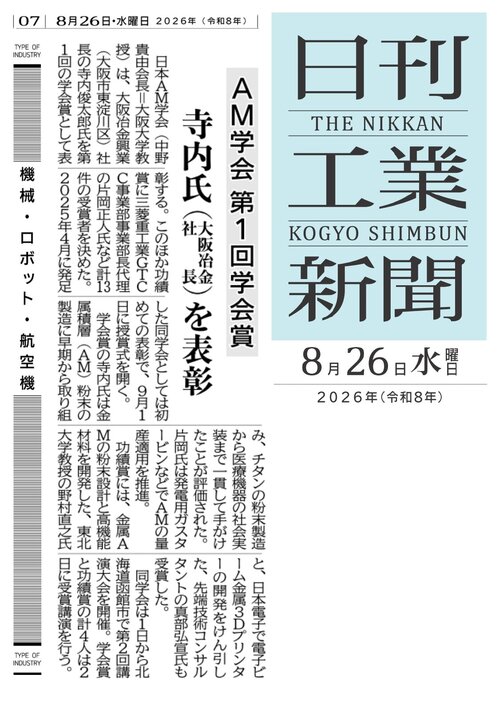
2026.08.24
【視察】株式会社島津製作所の山本靖則代表取締役社長をはじめとする役員の皆様が、 3DPTec統合センターをご視察されました。
株式会社島津製作所の山本靖則代表取締役社長をはじめとする役員の皆様が、 3DPTec統合センターをご視察されました。
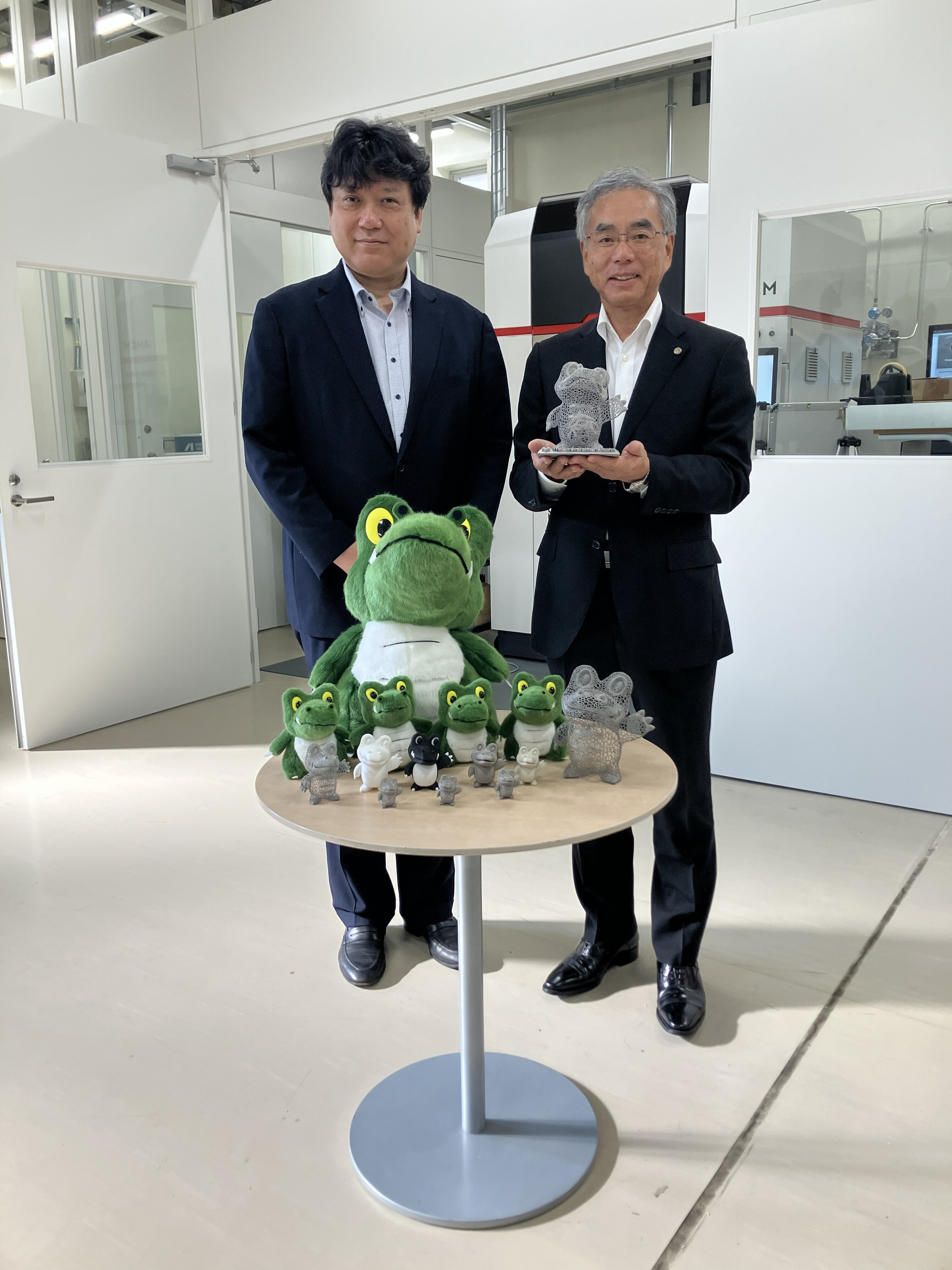
島津製作所 山本社長とともに
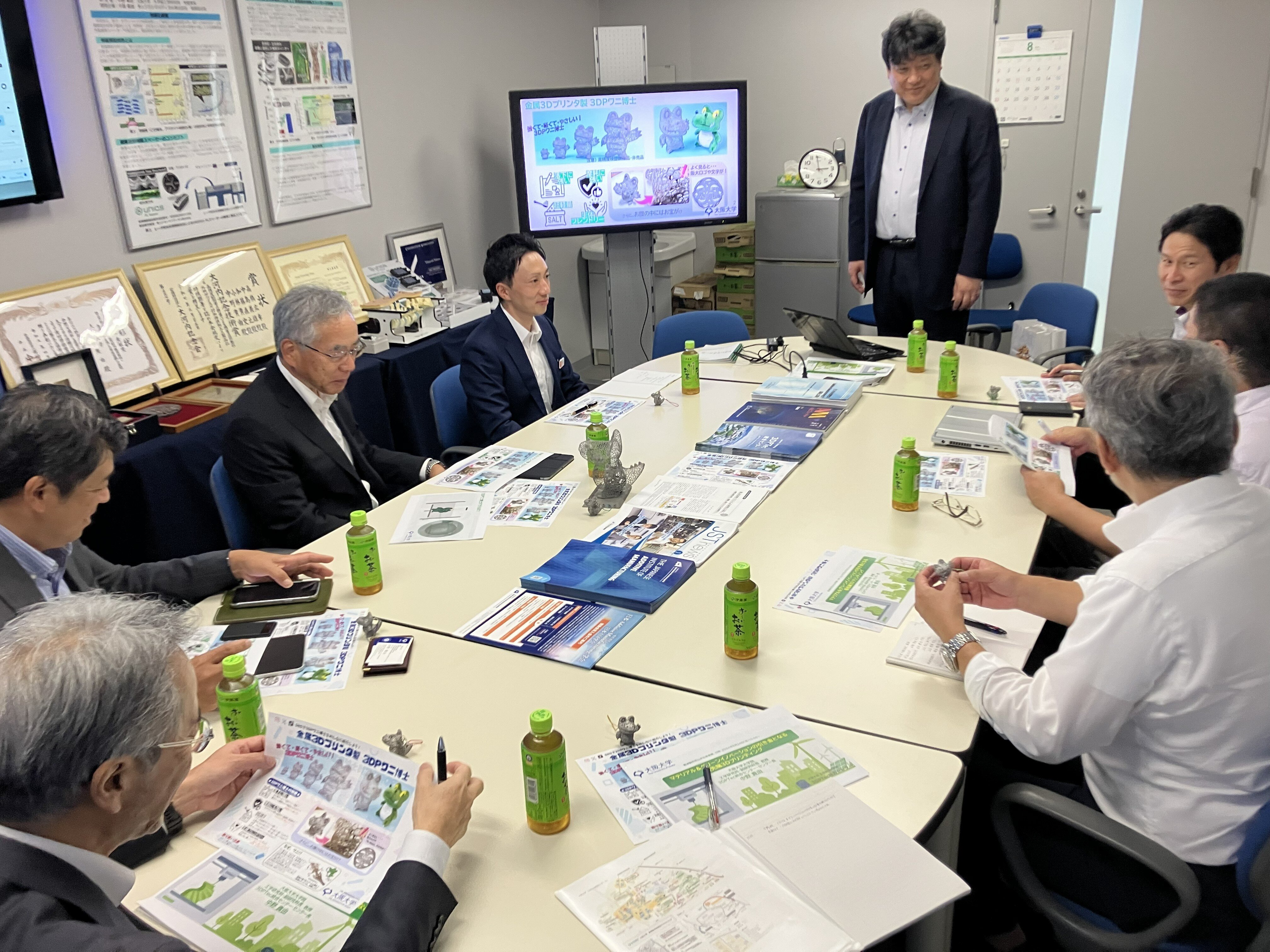
ディスカッションの様子
2026.08.23
【論文】ISIJ Internationalにステンレス鋼において層状構造を消すための方法に関する論文が掲載されました。
Ryosuke Ozasa, Ryota Watanabe, Shogo Hirata, Takuya Ishimoto, Takayoshi Nakano*:
Development of a single-crystalline-like texture in 316L stainless steel using a novel brick scan strategy in laser-powder bed fusion,
ISIJ International, 66 [9], (2026), 1066-1071.
DOI: https://doi.org/10.2355/isijinternational.ISIJINT-2026-079
論文はこちら
PDFはこちら
Abstract
As the properties of metallic materials depend on their crystallographic texture, the development of a strong texture is essential for functional control. This study achieved a single-crystalline-like texture with a hierarchical microstructure in 316L stainless steel (316L SS) through laser-powder bed fusion (L-PBF). A conventional ±X-scan strategy (employing bi-directional scanning along the x-axis for all layers) afforded a unique microstructure in which two differently oriented grains (<001> and <011> along the z-axis) appeared alternately. On the other hand, a novel ±X-brick-scan strategy, which employs bi-directional scanning along the x-axis for all layers while shifting the laser irradiation position by half a pitch between layers, afforded a single-crystalline-like texture with <011> orientation along both the z- and y-axes. The difference in texture originates from the crystal growth direction. In the ±X-brick-scan strategy, the <001> growth direction was inclined by approximately ±45° from the z-axis, whereas it aligned parallel to the z-axis at the melt pool bottom in the ±X-scan strategy. Notably, this growth behavior does not fully correspond to the calculated heat-flow direction in the ±X-brick-scan case. These results suggest that the crystal growth direction in L-PBF is governed not only by heat flow, but also by additional factors such as interfacial energy.
keywords: crystallographic texture; crystal growth; microstructure; laser-powder bed fusion; 316L stainless steel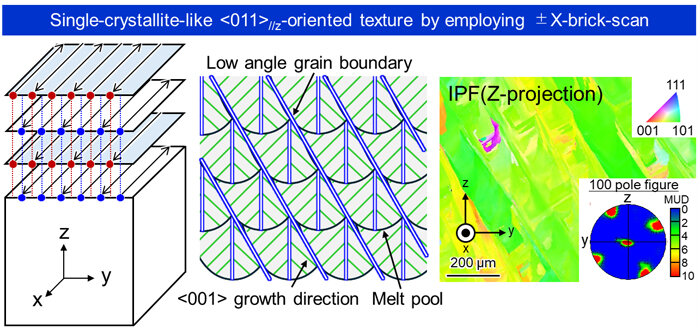
2026.08.21
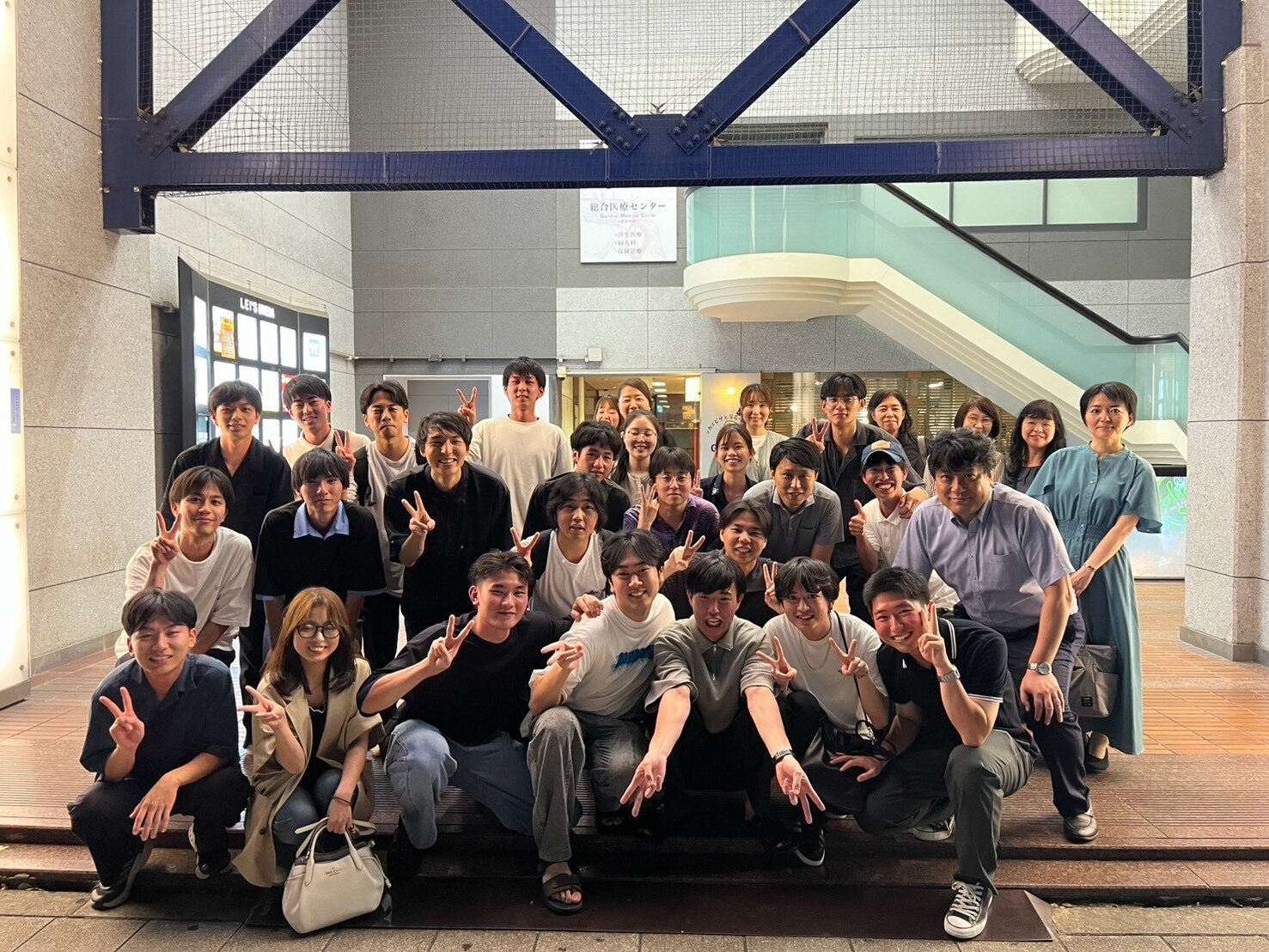
【行事】中野研の院試お疲れ様会を行いました。
今年は5名の修士課程受験(4名は推薦入試で既に合格)、3名の博士後期課程受験でした。全員の合格を願っています!後期も活気のある研究室にしていきましょう!!
2026.08.18
【講演】中野先生が東京大学医学部附属病院整形外科教室でセミナー講演を行いました。
中野貴由:骨質としての骨基質配向性とそれを考慮した金属3Dプリンタ製脊椎スペーサーの臨床応用
オルソペディックセミナー
2026年8月18日(火) 17:30~18:30
東京大学医学部附属病院・臨床研究棟
2026.08.17
【論文】AMで層状組織を方向制御したβTiAl合金の形成と機械的性質に関する論文がJournal of Alloys and Compoundsに受理され、掲載されました。
Sung-Hyun Park, Ozkan Gokcekaya, Kazuhisa Sato, Hyoung Seop Kim, Myung-Hoon Oh, Takayoshi Nakano*:
Formation and mechanical properties of oriented lamellar microstructures in a β-solidifying γ-TiAl alloy fabricated by laser powder bed fusion,
Journal of Alloys and Compounds, 1080, (2026), 190423: 1-12.
DOI: https://doi.org/10.1016/j.jallcom.2026.190423
論文はこちら
PDFはこちら
Abstract
A highly oriented lamellar microstructure was achieved in a β-solidifying γ-titanium aluminide (γ-TiAl) alloy fabricated via laser powder bed fusion (L-PBF) followed by heat treatment. The investigated alloy composition was Ti-44Al-6Nb-1.2Cr (at.%), the optimized processing condition resulted in βo/α₂ lamellae aligned parallel to the build direction (BD) and α₂/6H long-period stacking ordered (LPSO) lamellae tilted at ± 45° from the BD. The βo/α₂ lamellae were completed by the formation of a single crystalline-like texture with {011}z<100>x orientation in β phase, variant selection in α₂ phase with the Burgers orientation relationship. Additionally, the 6H-LPSO structure, which formed from the α₂ phase, was aligned parallel to the (0001)α₂ plane after heat treatment. Thus, the orientation of α₂/6H-LPSO was determined by the previous as-built crystallographic texture and subsequent variant selection in the α₂ phase.
The heat-treated specimen exhibited superior mechanical properties, achieving a tensile strength to fracture of 475.2 ± 52.1 MPa at room temperature and a yield strength of 523.7 ± 8.5 MPa, an ultimate tensile strength of 705.5 ± 21.4 MPa, and an elongation of 8.5 ± 1.4% at 800 °C, respectively. The enhanced strength was mainly attributed to the refined microstructure induced by the rapid solidification characteristics of the L-PBF process, which effectively impeded dislocation motion. In addition, the highly oriented lamellar microstructure promoted tortuous crack propagation accompanied by crack deflection and branching, thereby enhancing damage tolerance and elongation. Consequently, the present study demonstrates the strong potential of the L-PBF process for advanced microstructural control in high-performance γ-TiAl alloys.
keywords: Laser powder bed fusion; γ-TiAl alloy; Crystallographic texture; Variant selection; Oriented lamellae
2026.08.17
【論文】Taylor & FrancisのTransactions of the IMFにバイオフィルムに関する論文がオンラインで公開されました。
Hideyuki Kanematsu*, Akiko Ogawa, Ryoichi Ichino, Takayoshi Nakano:
International Standards for Evaluating Antibacterial, Antiviral, and Antibiofilm Properties of Surface-Finished Materials: A Critical Review
Transactions of the IMF, 104[5], (2026), 240-249
DOI: https://doi.org/10.1080/00202967.2026.2706346
論文はこちら
PDFはこちら
Abstract
International standards such as ISO 22196, ISO 21702, and ISO 4768:2023 provide essential frameworks for evaluating the antibacterial, antiviral, and antibiofilm properties of plastics and other non-porous surfaces. Although these standards have greatly contributed to reproducible performance assessment, they remain primarily endpoint-based biological assays and do not fully integrate the physicochemical characteristics of engineered material surfaces. This critical review compares the scientific basis, experimental assumptions, and practical limitations of the three standards from a surface engineering perspective. Particular attention is given to the film-contact principle, crystal violet staining, metal ion dissolution, wettability, surface roughness, intermolecular forces, and extracellular polymeric substances (EPS). The discussion encompasses representative biofilm-forming organisms - including Pseudomonas aeruginosa and Staphylococcus aureus, fungal species such as Candida albicans and Rhodotorula mucilaginosa, and industrially relevant Bacillus and Micrococcus species - whose behaviour on engineered surfaces underpins the rationale for each standard. The review argues that antibacterial, antiviral, and antibiofilm evaluations should not be treated as isolated test categories, because all are governed by common surface - microorganism interactions. At the same time, important gaps remain, including the lack of standardised flow-based antibiofilm testing, insufficient treatment of mixed-species biofilms, and limited requirements for surface characterisation. Future standardisation should therefore move beyond pass/fail biological activity values and incorporate materials descriptors, real-time monitoring, and predictive approaches such as electrochemical impedance spectroscopy, image analysis, and digital twin modelling. Such integration will strengthen the scientific basis of anti-infective surface design and improve the reliability of performance claims for practical applications.
keywords: Antibacterial; antiviral; antibiofilm; ISO 22196; ISO 21702; ISO 4768; biofilm; surface engineering
2026.08.17
【書籍】小泉先生、中野先生、石本先生らが編集し、中野研のスタッフが執筆した書籍が2027年1月にSpringer Natureから出版予定です。
Editors: Yuichiro Koizumi, Takayoshi Nakano, Yoshitaka Adachi, Kohei Morishita, Kazuhisa Sato, Yoshiaki Toda, Takuya Ishimoto, Teiichi Kimura, Eric Jägle, Albert C. To
Book Title: Creation of Materials by Super-Thermal Field in Additive Manufacturing
Book Subtitle: Science of Neo-3D Printing
Jan 2027
Series Title: The Materials Research Society Series
Publisher: Springer Singapore
https://link.springer.com/book/9789819204922#about-this-book
Hardcover ISBN
978-981-92-0492-2 Due: 11 February 2027
Softcover ISBN
978-981-92-0495-3 Due: 11 February 2028
eBook ISBN
978-981-92-0493-9
Series ISSN
2730-7360
Series E-ISSN
2730-7379
2026.08.01
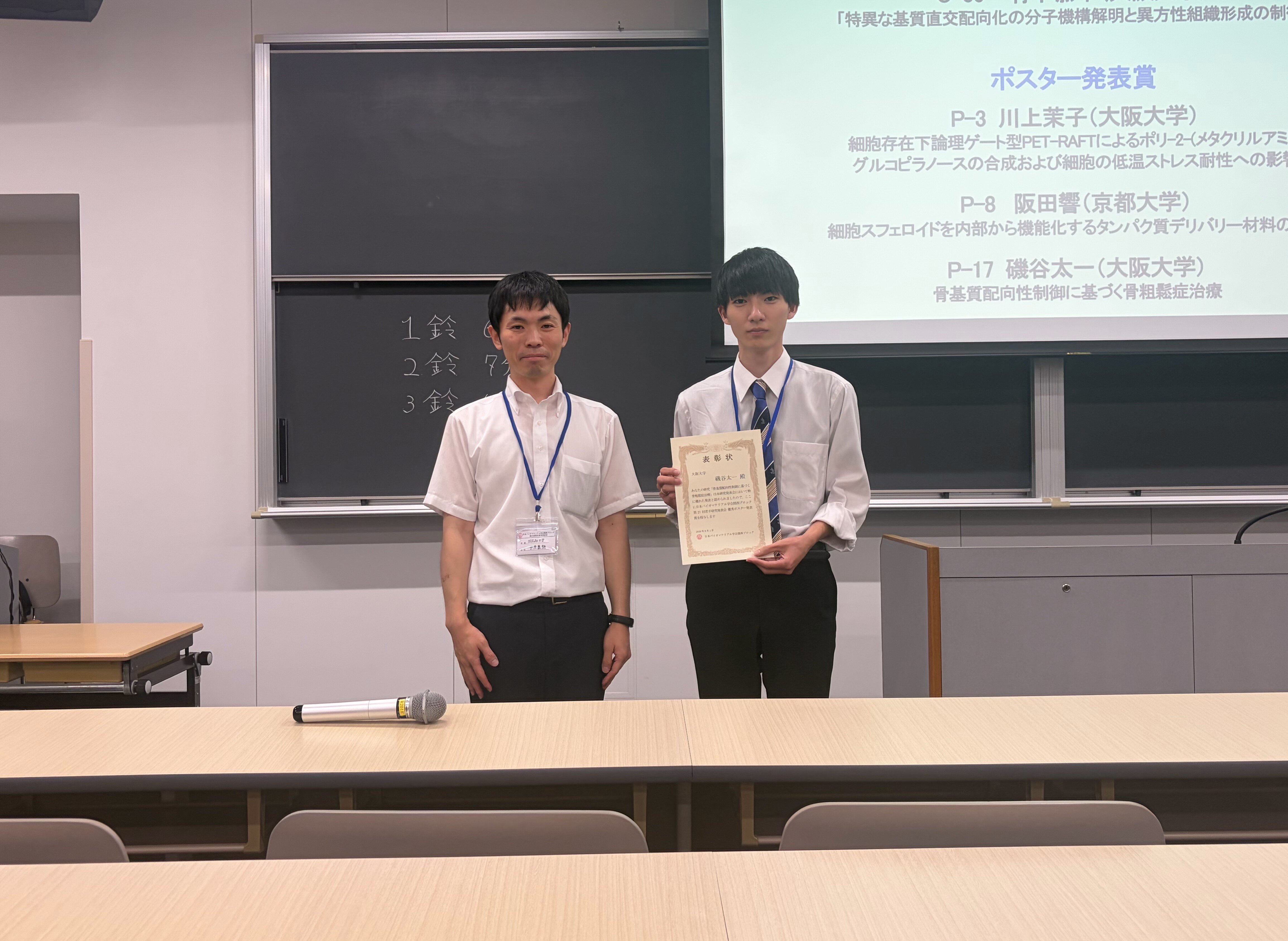
【受賞】日本バイオマテリアル学会関西ブロック 第21回若手研究発表会(@同志社大学新町キャンパス臨光館)にて、M2竹下くんが優秀口頭発表賞を、M2磯谷くんが優秀ポスター発表賞を受賞しました。
○[O-06] 特異な基質直交配向化の分子機構解明と異方性組織形成の制御
竹下恭平、中西陽平、松坂匡晃、松垣あいら、中野貴由
○[P-17] 骨基質配向性制御に基づく骨粗鬆症治療
磯谷太一、松坂匡晃、松垣あいら、中野貴由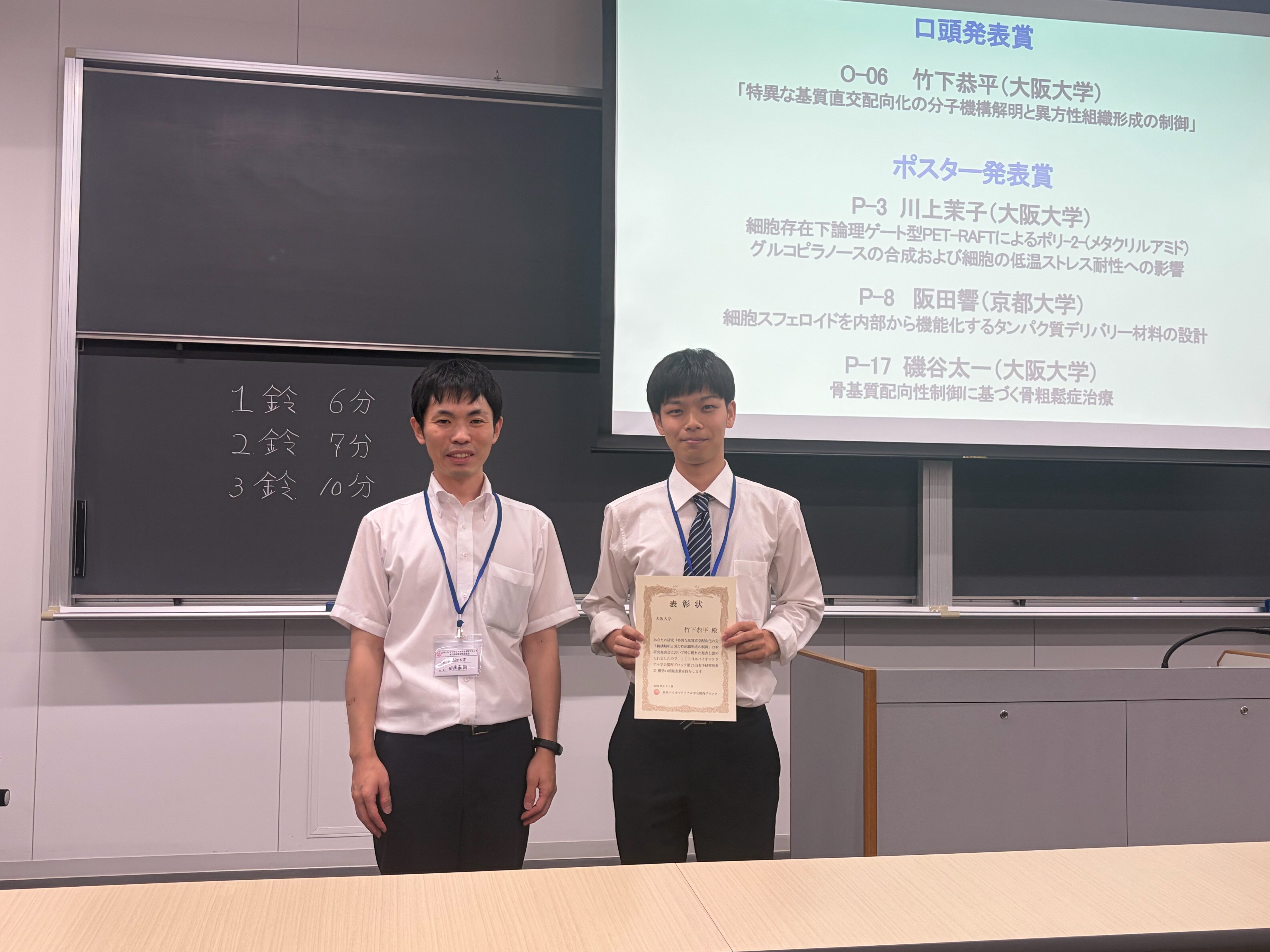
2026.08.01
【学会】日本バイオマテリアル学会関西ブロック 第21回若手研究発表会(@同志社大学新町キャンパス臨光館、2026年8月1日)に参加しました。
○[O-06] 特異な基質直交配向化の分子機構解明と異方性組織形成の制御
竹下恭平、中西陽平、松坂匡晃、松垣あいら、中野貴由
○[P-17] 骨基質配向性制御に基づく骨粗鬆症治療
磯谷太一、松坂匡晃、松垣あいら、中野貴由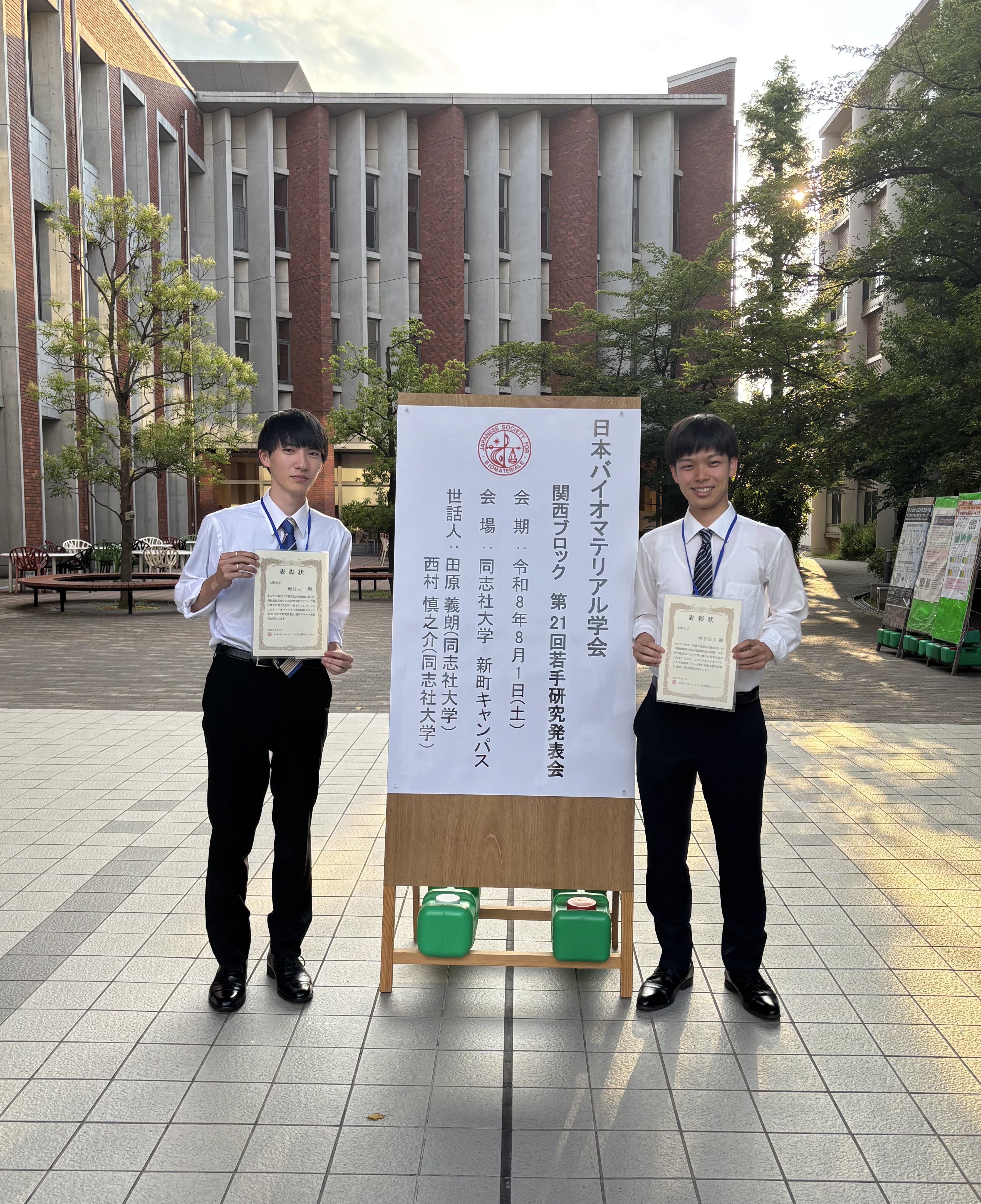
2026.08.01
【展示】チタン合金製『3DPワニ博士』の紹介リーフレットを作成しました
大阪大学の公式キャラクター「ワニ博士」を、金属3Dプリンティング(電子ビーム粉末床溶融結合法)で立体化した「3DPワニ博士」の紹介リーフレットを作成しました。
3DPワニ博士は、生体用チタン合金の粉末に電子ビームを照射し、一層ずつ積み上げて造形しています。力が集中しにくい六角形メッシュ構造の採用と、電子ビーム熱源による残留応力の低減により、落下にも強い設計となっています。また、金属3Dプリンティングならではの超急冷凝固によって高硬度・高強度化を実現しており、これは日本刀と同じ強化メカニズムです。
チタン合金製のため非常に軽く、小型サイズ(4.5 cm)は小さじ一杯の塩よりも軽い6 g以下、身長18 cmの特大サイズでも100 g以下です。生体用チタン合金を使用しているため、無毒で、体にも環境にも優しい素材でできています。
さらに、金属3Dプリントでは、閉じた空洞の中に別の立体を造形するといった複雑なデザインが可能です。3DPワニ博士のお腹の中にも「お宝」が入っています。振ってみると...? よく見ると阪大ロゴや「Dr.Wani」の文字も隠れています。
ワニ博士のモデルは、1964年に本学豊中キャンパスで発見された日本初のワニ類化石「マチカネワニ」です。この化石は2025年に国の天然記念物に指定されました。
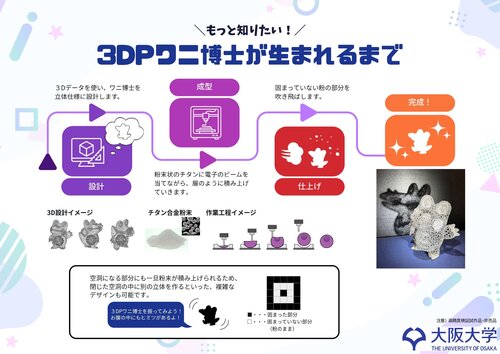
紹介リーフレットでは、3DPワニ博士の特徴に加えて、設計から成型・仕上げまでの造形プロセスもイラストで分かりやすく紹介しています。ぜひご覧ください。
★★★3DPワニ博士の紹介.pdf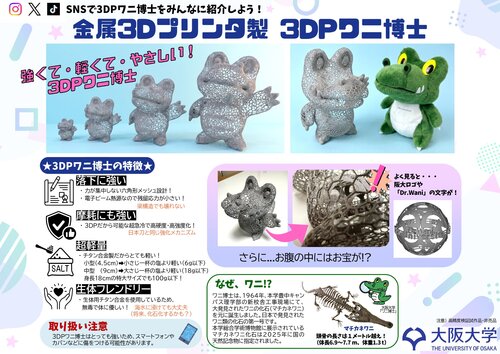
2026.07.31
【行事】M2の皆さんの就職内々定お祝い会を行いました。
屋上BBQビアガーデン UMEDA大ホールにて、就職内々定のお祝い会を開催しました。
M2の皆さん、おめでとうございます!!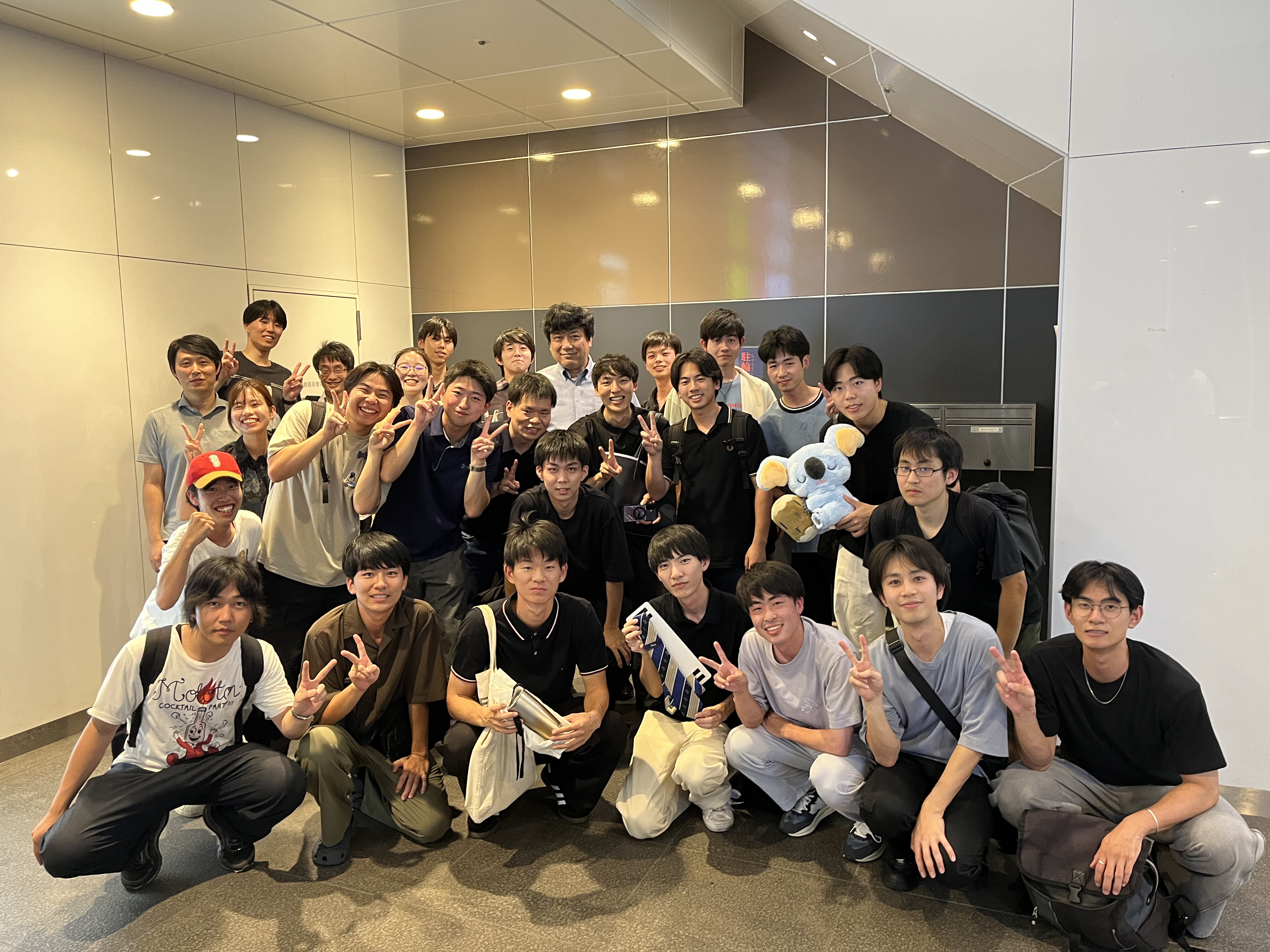
過去の情報
- 2026年 1月~6月 | 7月~12月
- 2025年 1月~6月 | 7月~12月
- 2024年 1月~6月 | 7月~12月
- 2023年 1月~6月 | 7月~12月
- 2022年 1月~6月 | 7月~12月
- 2021年 1月~6月 | 7月~12月
- 2020年 1月~6月 | 7月~12月
- 2019年 1月~6月 | 7月~12月
- 2018年 1月~6月 | 7月~12月
- 2017年 1月~6月 | 7月~12月
- 2016年 1月~6月 | 7月~12月
- 2015年 1月~6月 | 7月~12月
- 2014年 1月~6月 | 7月~12月
- 2013年 1月~6月 | 7月~12月
- 2012年 1月~6月 | 7月~12月
- 2011年 1月~6月 | 7月~12月
- 2010年 1月~6月 | 7月~12月
- 2009年 1月~6月 | 7月~12月
- 2008年 1月~6月 | 7月~12月